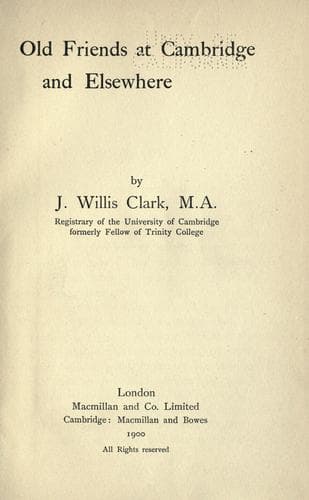
Old Friends at Cambridge and ElsewhereClark, John Willis
History
Old Friends at Cambridge and Elsewhere
Clark, John Willis
University of Cambridge -- History
From the study of manuscripts to their transcription and publication the
transition is easy, and we need therefore find no difficulty in
accounting for his employment by the Master of the Rolls. He began his
work on that series in 1858 by editing certain _Lives of Edward the
Confessor_, written in old French. This work, on which he had bestowed
infinite pains, was not free from errors. The study of the language in
which it is written was not understood at that time as it is now, and it
is no discredit to Luard’s memory to admit that he was not fully
prepared for the task. But such mistakes as he made are no justification
for the savage and personal attack to which he was subjected, eleven
years afterwards, by a critic who ought to have known better. I do not
feel that this is the place to criticise, or even to mention, the long
list of historical works that Luard subsequently edited, the last of
which appeared not long before his death. His labours in this field of
research have been better appreciated in Germany than in England, but
even here scholars like Bishop Stubbs and Professor Freeman have spoken
with cordial appreciation of the value of his work. It is worth noting
too that here his passion for old methods of editing deserted him;
nothing can be more thoroughly modern than his treatment of these
ancient records. Nor can I leave this part of my subject without
noticing his indexes. He was the very prince of index-makers; every
sheet, before it was finally passed for press, was fully indexed, with
the result that not only were mistakes recognised and corrected, but the
index itself, worked out on a definite system conceived from the
beginning, was carried through to a satisfactory conclusion without
haste or weariness, and became a real catalogue of the subjects referred
to in the work itself.
Luard was Registrary of the University from 1862 to his death in 1891.
To this work he brought the same painstaking accuracy, and the same
unselfish readiness to endure hard work, that distinguished his other
labours. The ordinary duties of his office were discharged with
marvellous rapidity, and almost painful attention to detail; and the
records were admirably re-arranged. Mr Romilly, his predecessor, had
brought order out of confusion, and prepared an excellent catalogue on
modern lines; but Luard went a step farther. He bound the contents of Mr
Romilly’s bundles in a series of volumes, each of which he indexed with
his own hand. These separate indexes were then transcribed, and finally
bound together so as to form a complete catalogue of the contents of the
Registry. Every paper can now be found with the least possible loss of
time, while each bound volume contains a complete history of the subject
to which it relates, so far as it can be illustrated by documents in the
Registry.
Public-domain text, read in full here on John Shaqi.
Reviews
Reviews
No reviews yet
Be the first to share your thoughts on this work.
Elsewhere in the archive
Join the Discussion
Join the discussion
Sign in to leave a comment or review.
Sign InorCreate an account