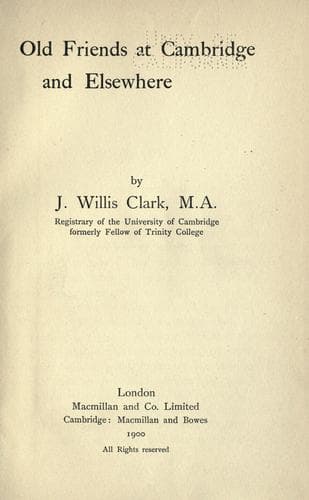
Old Friends at Cambridge and ElsewhereClark, John Willis
History
Old Friends at Cambridge and Elsewhere
Clark, John Willis
University of Cambridge -- History
This he performed in a perfunctory fashion that did not
please the Council, and difficulties arose between that body and their
distinguished servant which time only rendered more acute. It may be
that the Council were not sufficiently sensible of the honour reflected
upon the college by possessing ‘the first anatomist of the age’; and
Owen, on his side, may have been too fond of doing work which brought
‘grist to the mill,’ and applause, and troops of friends, without being
directly connected with the college. However this may have been, it is
beyond dispute that Owen’s removal, in 1856, to the British Museum, was
a fortunate solution of a difficulty which otherwise would probably have
ended in an explosion.
It has been already mentioned that when the Hunterian Museum was
entrusted to the care of the College of Surgeons it had been stipulated
that its contents should be illustrated by an annual course of
twenty-four lectures. Up to 1836 this course had been divided between
the professors of anatomy and surgery; but in that year Owen was
appointed first Hunterian Professor of Comparative Anatomy and
Physiology. To the last days of his life he constantly referred to the
pleasure which this appointment gave him when first conferred upon him;
nor did this feeling wear off as time went on. He gave his lectures
regularly, with the same keen interest and thoroughness of preparation,
down to 1855. At first he confined himself strictly to his prescribed
subject; but gradually he widened his field, and introduced whatever
views or subjects happened to be interesting him. Most of the lectures
were worked up into books afterwards. He was an admirable lecturer—in
fact, he was better as a lecturer than as a writer; for it must be
confessed that his scientific style is often pedantic and cramped, and
he seems to use words rather for the sake of concealing his thoughts
than of imparting them. It is interesting to learn what pains he took
with his early lectures—how he rehearsed them to his wife, or to a
friend, till he got used to the work, and could estimate exactly how
much would fill the allotted hour. We cannot refrain from quoting Mrs
Owen’s account of the first lecture:
‘So busy all the morning; had hardly time to be nervous, luckily for me.
R. robed in the drawing-room, and took some egg and wine before going
into the theatre. He then went in and left me. At five o’clock a great
noise of clapping made me jump, for I timed the lecture to last a
quarter of an hour longer; but R., it seems, cut it short rather than
tire Sir Astley Cooper too much. All went off as well as even I could
wish. The theatre crammed, and there were many who could not get places.
R. was more collected than he or I ever supposed, and gave this awful
first lecture almost to his own satisfaction! We sat down a large party
to dinner. Mr Langshaw and R. afterwards played two of Corelli’s
sonatas’ (i. 109).
Public-domain text, read in full here on John Shaqi.
Reviews
Reviews
No reviews yet
Be the first to share your thoughts on this work.
Elsewhere in the archive
Join the Discussion
Join the discussion
Sign in to leave a comment or review.
Sign InorCreate an account