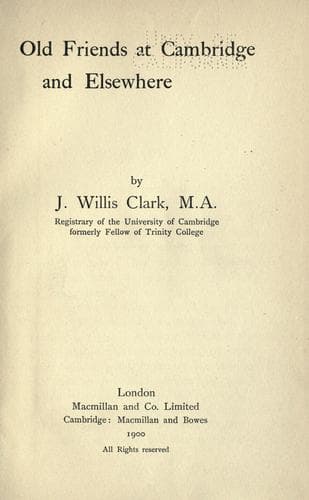
Old Friends at Cambridge and ElsewhereClark, John Willis
History
Old Friends at Cambridge and Elsewhere
Clark, John Willis
University of Cambridge -- History
He was also a mark for many of those questions, serious and absurd
alike, which are presented for solution to men of science. A firm of
undertakers asked him how much they ought to charge for embalming Mr
Beckford; a grave Oriental from the Turkish Embassy submitted to his
examination the bowl of a tobacco-pipe which he believed to have been
made out of the beak of a Phœnix; his opinion was sought by the Home
Office on the window-tax, and by Charles Dickens on the publicity of
executions; his microscopical skill was brought to bear on the so-called
contemporary annotations of Shakespeare; and he demolished one of the
many sea-serpents in which a marvel-loving public from time to time
believes. He showed very conclusively that it was probably a large seal.
His letter to the _Times_ on the subject excited a good deal of
attention, and Prince Albert dubbed him ‘the serpent-killer.’ He was
also to a certain extent responsible for the models of extinct animals
in the gardens of the Crystal Palace at Sydenham, and was rewarded for
his trouble by a dinner in the spacious carcase of the Iguanodon.
In 1856—it is said, through the influence of Lord Macaulay—Owen was
appointed Superintendent of the Department of Natural History at the
British Museum, with a salary of £800 a year. The new officer was to
stand towards the collections of natural history in the same relation
that the librarian did towards the books and antiquities, and to be
directly responsible, as he was, to the trustees. Great advantages were
expected to result from this new departure, and Owen was warmly
congratulated. Professor Sedgwick wrote:
‘I trust that your move to the British Museum is for your happiness. If
God spare your health, it will be a grand move for the benefit of
British science. An _Imperator_ was sadly wanted in that vast
establishment’ (ii. 19).
With Lord Macaulay, anxiety for Owen himself had been paramount:
‘I am extremely desirous that something should be done for Owen. I
hardly know him to speak to. His pursuits are not mine; but his fame is
spread over Europe. He is an honour to our country, and it is painful to
me to think that a man of his merit should be approaching old age amidst
anxieties and distresses. He told me that eight hundred a year, without
a house in the Museum, would be opulence to him’ (ii. 15).
Public-domain text, read in full here on John Shaqi.
Reviews
Reviews
No reviews yet
Be the first to share your thoughts on this work.
Elsewhere in the archive
Join the Discussion
Join the discussion
Sign in to leave a comment or review.
Sign InorCreate an account