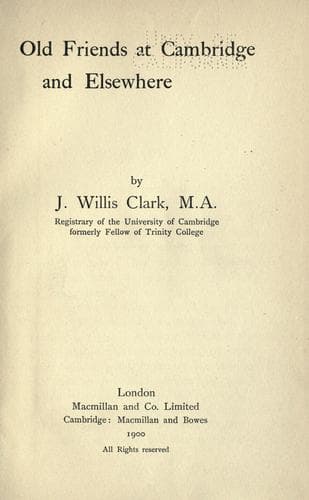
Old Friends at Cambridge and ElsewhereClark, John Willis
History
Old Friends at Cambridge and Elsewhere
Clark, John Willis
University of Cambridge -- History
A little foresight might have saved much disappointment. The subordinate
officers, whom Owen was expected to influence, owed no allegiance to
him, and resented his intrusion; they had long been practically
independent within their own departments, and desired to remain so. Such
a situation would have been difficult even for a born leader of men; but
for Owen, whose gifts did not lie in that direction, it meant either
resignation or acceptance of the inevitable. He chose the latter, and,
dropping the sword of a despot, assumed the peaceful mantle of a
constitutional sovereign. His reputation did good service to the
collections in the way of attracting specimens of all kinds from all
parts of the world; and he exerted himself with exemplary diligence to
obtain special _desiderata_; but otherwise his duties as administrator
soon became little more than nominal. There was, however, one subject
connected with the Museum which had long engaged his attention, and
which he had the pleasure to see settled before he died, though not
entirely on the lines he had at first laid down.
It had been manifest for a considerable period that the British Museum
was too small for the various collections, and two years before Owen’s
arrival Dr Gray, keeper of zoology, had made a definite request for
additional accommodation. The trustees, after much consideration, agreed
to a small, but wholly inadequate, extension of one of the galleries.
Owen did not act hastily, but, having thoroughly mastered the subject,
addressed a report to the trustees in 1859, in which he showed that,
having regard to the congestion of the existing galleries, the quantity
of specimens stored out of sight, and the probable rate of increase, a
space of ten acres ought to be acquired at once. This report was
accompanied by a plan, drawn by himself, in which several special
features may be noticed. A central hall was to contain an epitome of
natural history—specimens selected to show the type-characters of the
principal groups—called in subsequent editions of the plan the
Index-Museum; adjoining this hall there was to be a lecture-theatre;
zoology was to include physical ethnology, for which a gallery measuring
150 feet by 50 feet was to be provided; the Cetacea, stuffed specimens
and skeletons, were to have a long gallery to themselves; and lastly,
paleontology was no longer to be separated from zoology, but the gallery
containing the one was to be readily entered from the gallery containing
the other. A plan so novel, so enlightened, so truly imperial as this,
was far too much in advance of the age to meet with anything except
opposition and ridicule. When it was debated in the House of Commons, Mr
Gregory, M.P. for Galway, got it referred to a Select Committee,
regretting, in reference to its author, ‘that a man whose name stood so
high should connect himself with so foolish, crazy, and extravagant a
scheme.’ Owen’s first idea had been to purchase the land required at
Public-domain text, read in full here on John Shaqi.
Reviews
Reviews
No reviews yet
Be the first to share your thoughts on this work.
Elsewhere in the archive
Join the Discussion
Join the discussion
Sign in to leave a comment or review.
Sign InorCreate an account