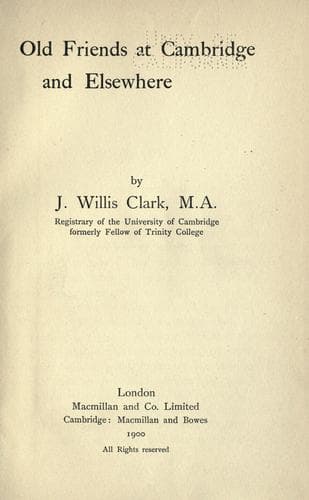
Old Friends at Cambridge and ElsewhereClark, John Willis
History
Old Friends at Cambridge and Elsewhere
Clark, John Willis
University of Cambridge -- History
Bloomsbury; but on this point he had no very decided personal opinion,
and, yielding to that of the majority of men of science, he advocated by
lecture, by conversation, and in print, the removal of the collections
of natural history to a new and distant site. For this scheme he
fortunately secured the powerful advocacy of Mr Gladstone, then
Chancellor of the Exchequer, who moved (May 12, 1862) for leave to bring
in a Bill to effect it. These excellent intentions were thwarted by Mr
Disraeli, who, knowing no more about science than he did about
primroses, saw only a chance of obstructing a political opponent; and
once more the scheme was adjourned. The adjournment, however, was of
short duration, for in 1863 Parliament voted the purchase of five acres
at South Kensington, which Owen presently persuaded the Government to
increase to eight; but further delays, extending over nearly twenty
years, ensued, and when Owen resigned in 1883 the collections were not
yet completely arranged in their new home.
The Museum as completed is widely different from that which Owen
originally prescribed. The gallery of ethnology is gone; the Cetacea are
relegated, as at Bloomsbury in former days, to a cellar; there is no
lecture-theatre; and, in fact, the index-museum is almost the only
special feature which has survived, but even this was not arranged by
himself. On one vital question of arrangement, moreover, Owen allowed
his own views to be overruled. So early as 1842 he had reported to the
Council of the College of Surgeons on the expediency of combining the
fossil and recent osteological specimens, pointing out that
‘the peculiarities of the extinct mastodon, for example, cannot be
understood without a comparison with the analogous parts of the elephant
and tapir; nor those of the ichthyosaurus without reference to the
skeletons of crocodiles and fishes. The proper position of such
specimens in the Museum is, therefore, between those series of skeletons
of which they present transitional or intermediate structures.’
An arrangement of the recent and fossil collections in accordance with
these most reasonable and philosophical views appears in all the
versions of the plan until the last; now it has entirely disappeared,
and the two collections are disposed in opposite wings of the building
widely severed from each other. Owen had no special turn for
organization, and he was probably in a minority of one against his
colleagues on this point. Besides this, his fighting days were over, and
he preferred peace to an ideal arrangement of which his contemporaries
could not see the advantages.
Owen turned his enforced leisure at the British Museum to good account,
and proceeded, with renewed activity, to occupy himself in various
directions. In 1857 he gave lectures on paleontology at the Royal School
of Mines, and his first course seems to have evoked the enthusiasm of
his earlier days. Said Sir Roderick Murchison:
Public-domain text, read in full here on John Shaqi.
Reviews
Reviews
No reviews yet
Be the first to share your thoughts on this work.
Elsewhere in the archive
Join the Discussion
Join the discussion
Sign in to leave a comment or review.
Sign InorCreate an account