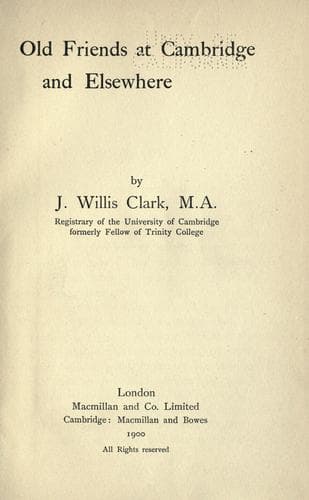
Old Friends at Cambridge and ElsewhereClark, John Willis
History
Old Friends at Cambridge and Elsewhere
Clark, John Willis
University of Cambridge -- History
In this same year (1837) the _History of the Inductive Sciences_ was
published, to be followed in less than three years by the _Philosophy_
of the same. This encyclopædic publication—for the two books must be
considered together—marks the conclusion of that part of his life which
had been devoted, in the main, to pure science; and it gives the reason
for his having thrown himself into occupations so diverse. It was not
his habit to write on that which he had not completely mastered; and he
therefore thought, wrote, and published on most of the separate sciences
while tracing their history and developing their philosophy.
In this rapid sketch we have not been able to do more than indicate the
principal works which Whewell had had in hand. It must not be forgotten
that at the same time he was engaged in a large and ever-increasing
correspondence; writing letters—which, as he used to say himself, ought
to be ‘postworthy’—not merely to scientific men, as we know from Mr
Todhunter’s book, but—as we now know from Mrs Stair Douglas—to his
sisters and other ladies, on all sorts of subjects which he thought
would interest them. Then he was a wide reader, as is proved by notes he
made on the books which he had read from 1817 to 1830: ‘books in almost
all the languages of Europe; histories of all countries, ancient or
modern; treatises on all sciences, moral and physical. Among the notes
is an epitome of Kant’s _Kritik der reinen Vernunft_, a work which
exercised a marked influence on all his speculations in mental
philosophy.’ Whatever he read, he read thoroughly. Mr Todhunter
illustrates this by a story given on the authority of one of his oldest
friends. He was found reading Henry Taylor’s _Philip van Artevelde_,
which then had just appeared. Not content with the poem alone, however,
he had Froissart by his side, and was carefully comparing the modern
drama with the ancient chronicle. Lastly—and we put the subject we are
now about to mention last, not because it was least, but because it was,
or ought to have been, the most important of all his occupations—he held
the office of tutor of one of the three _sides_, as they were called,
into which Trinity College was then divided, first alone, and next in
conjunction with Mr Perry, from 1823 to 1838.
Public-domain text, read in full here on John Shaqi.
Reviews
Reviews
No reviews yet
Be the first to share your thoughts on this work.
Join the Discussion
Join the discussion
Sign in to leave a comment or review.
Sign InorCreate an account