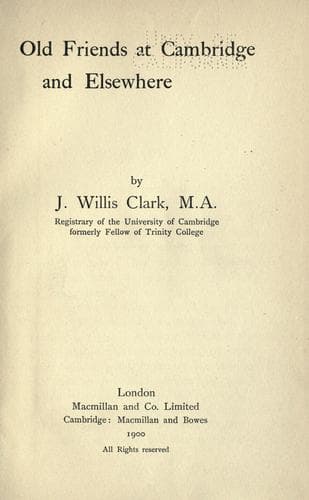
Old Friends at Cambridge and ElsewhereClark, John Willis
History
Old Friends at Cambridge and Elsewhere
Clark, John Willis
University of Cambridge -- History
At that time the College was far smaller than it is at present, and a
tutor was able, if he chose, to see much more of his pupils, to form
some appreciation of their tastes and capacities, and personally to
direct their studies. A man who combines the varied qualities which a
thoroughly good tutor ought to possess is not readily found. It is a
question of natural fitness rather than of training. In the first place,
he must be content to forego all other occupations, and to be at the
beck and call of his pupils and their parents whenever they may choose
to come to him. Secondly, he must never forget that the dull, the idle,
and the vicious demand even more care and time than the clever and the
industrious. It may seem almost superfluous to mention that nothing
which concerns his pupils must be beneath his notice. Petty details
which concern their daily life, their rooms, their bills, their domestic
relations, their amusements, have all to be referred to the tutor; and
the most trivial of these may not seldom be of the greatest importance
in giving occasion for exercising influence or administering advice. We
are sorry to have to admit that Whewell was hardly so successful as he
ought to have been in discharging these arduous duties. The period of
his tutorship was, as we have shown, precisely that during which he was
most occupied with his private studies; he threw his energies into them,
and disposed of his College work in a perfunctory fashion. His letters
are full of such passages as: ‘I have got an infinitude of that trifling
men call business on my hands’; ‘During the last term I have been almost
too busy either to write or read. I took upon myself a number of
employments which ate up almost every moment of the day’; and the like;
and his delight at having transferred the financial part of the work to
his colleague Mr Perry, in 1833, was unbounded. The result was
inevitable; he could not give the requisite time to his pupils, and, in
fact, hardly knew some of them by sight. A story used to be current
about him which is so amusing that we think it will bear repeating. We
do not vouch for its accuracy; but we think that it would hardly have
passed current had it not been felt to be applicable. One day he gave
his servant a list of names of certain of his pupils whom he wished to
see at a wine-party after Hall, a form of entertainment then much in
fashion. Among the names was that of an undergraduate who had died some
weeks before. ‘Mr Smith, sir; why he died last term, sir!’ objected the
man. ‘You ought to tell me when my pupils die,’ replied the tutor
sternly; and Whewell could be stern when he was vexed. Again, his
natural roughness of manner was regarded by the undergraduates as
indicating want of sympathy. They thought he wanted to get rid of them
and their affairs as quickly as possible. Those who understood him
better knew that he was really a warm-hearted friend; and we have seen
Public-domain text, read in full here on John Shaqi.
Reviews
Reviews
No reviews yet
Be the first to share your thoughts on this work.
Join the Discussion
Join the discussion
Sign in to leave a comment or review.
Sign InorCreate an account