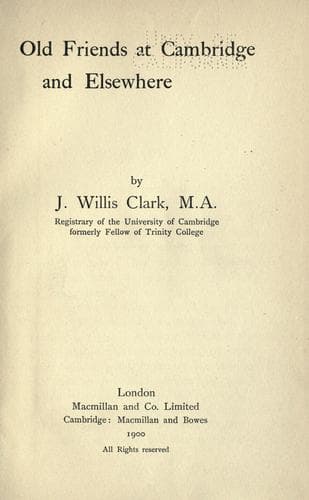
Old Friends at Cambridge and Elsewhere — John Shaqi
Old Friends at Cambridge and ElsewhereClark, John Willis
History
Old Friends at Cambridge and Elsewhere
Clark, John Willis
University of Cambridge -- History
As time went on, and Whewell approached his fiftieth year, he began to
feel that ‘College rooms are no home for declining years.’ His friends
were leaving, or had left; he did not make new ones; and he was
beginning to lead a life of loneliness which was very oppressive to him.
In 1840 he thought seriously of taking a College living, but his friend
Mr Hare dissuaded him; and the letters that passed between them on this
subject are among the most interesting in Mrs Stair Douglas’ volume. In
1841 he made up his mind to settle in Cambridge as a married man, with
his Professorship and his ethical studies as an employment. The lady of
his choice was Miss Cordelia Marshall. They were married on October 12,
1841, and on the very same day, Dr Wordsworth, Master of Trinity, wrote
to him at Coniston, where he was spending his honeymoon, announcing his
intention of resigning, ‘in the earnest _desire_, _hope_, and _trust_,
that _you_ may be, and _will_ be, my successor.’ The news, which seems
to have been quite unexpected, spread rapidly among the small circle of
Whewell’s intimate friends; and succeeding posts brought letters from Dr
Worsley and others, urging him ‘not to linger in his hymeneal Elysium,’
but to go up to London at once, and solicit the office from the Prime
Minister, Sir Robert Peel. Dr Whewell describes himself as ‘vehemently
disturbed’; most probably he was unwilling to comply with what seems to
us to have been extraordinary advice. He did comply, however, and went
to London, where he found a letter from Sir Robert, offering him the
Mastership. It is pleasant to be able to record that the offer was made
spontaneously, before any solicitations had reached the Minister.
Whewell accepted it on October 18; had an interview with Sir Robert on
the 19th; returned to Coniston by the night mail; and on the 23rd
(according to Mr Todhunter) had sufficiently recovered from his
excitement to sit down to compose the first lecture of a new course on
Moral Philosophy.
The appointment was felt to be a good one, though it must be admitted
that there were dissentient voices. It was notorious that Dr Wordsworth
had resigned soon after the fall of Lord Melbourne’s administration, in
order to prevent the election of either Dean Peacock or Professor
Sedgwick, both of whom were very popular with the Fellows. The feeling
in College, therefore, was rather against the new Master than with him.
Nor was he personally popular. We now know, from the letters which, in
reply to congratulations, he wrote to Lord Lyttelton, Bishop Thirlwall,
Mr Hare, and others, how diffident he was of his fitness for the office,
and how anxious to discharge its high duties becomingly. Mr Hare had
evidently been giving advice with some freedom, as was his wont, for
Whewell replies:
Public-domain text, read in full here on John Shaqi.
Reviews
Reviews
No reviews yet
Be the first to share your thoughts on this work.
Join the Discussion
Join the discussion
Sign in to leave a comment or review.
Sign InorCreate an account