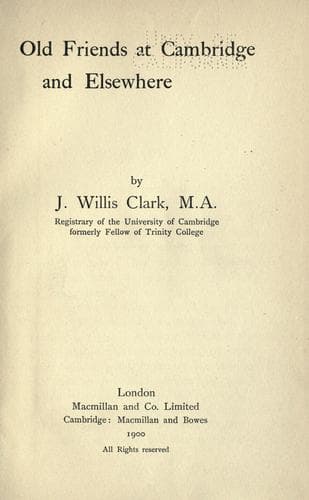
Old Friends at Cambridge and ElsewhereClark, John Willis
History
Old Friends at Cambridge and Elsewhere
Clark, John Willis
University of Cambridge -- History
that with his private pupils he had been exceedingly popular; but those
who came only occasionally into contact with him regarded him with fear,
not with affection. On the other hand, he was inflexibly just, whatever
gossip or malevolence may have urged to the contrary. He had no
favourites. No influence of any kind could make him swerve from the
lofty standard of right which he had prescribed for himself.
* * * * *
We left Whewell completing the _Philosophy of the Inductive Sciences_;
and for the future we shall find him turning his attention
exclusively—so far as he could be said to do anything exclusively—to
Moral Philosophy. In 1838 he was elected to the Knightbridge
Professorship, founded in 1677 by the Rev. John Knightbridge, who
directed his Professor of ‘Moral Theology or Casuistical Divinity,’ as
he termed it, to read five lectures in the Public Schools in every term,
and, at the end of it, to deliver them, fairly written out, to the
Vice-Chancellor. Various pains and penalties were enjoined against those
who failed to perform these duties; but, notwithstanding, the office had
remained a sinecure for more than a century; indeed we are doubtful
whether it had ever been anything else. The suggestion that Whewell
should become a candidate for it was made by his old friend, Dr Worsley,
Master of Downing, who was Vice-Chancellor in that year, and, by virtue
of his office, one of the electors. Whewell determined to inaugurate a
new era, and at once commenced a course of lectures, which were
regularly continued in subsequent years. We have seen that he had
prepared himself for these pursuits by previous studies; and his letters
show that he had made up his mind to devote himself to them for some
years to come. In 1845 he produced his _Elements of Morality_, wherein
the subject is treated systematically; and subsequently he wrote, or
edited, works devoted to special parts of it, as _Lectures on the
History of Moral Philosophy in England_; _Grotius de Jure Belli et
Pacis_; and the _Platonic Dialogues for English Readers_. The permanent
influence which Grotius exercised upon his mind is marked by his
munificent foundation of a Professorship and Scholarships in
International Law, in connexion with two additional courts for Trinity
College, one of which was built during his life-time, while for the
other funds were provided by his Will. The most sober-minded of men may
sometimes be a visionary; and the motto _Paci sacrum_, which Whewell
placed on the western façade of his new buildings, would seem to prove
that he seriously believed that his foundation would put an end to war,
and inaugurate ‘a federation of the world.’
Public-domain text, read in full here on John Shaqi.
Reviews
Reviews
No reviews yet
Be the first to share your thoughts on this work.
Join the Discussion
Join the discussion
Sign in to leave a comment or review.
Sign InorCreate an account