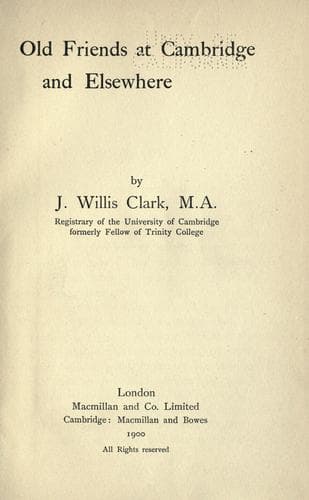
Old Friends at Cambridge and Elsewhere — John Shaqi
Old Friends at Cambridge and ElsewhereClark, John Willis
History
Old Friends at Cambridge and Elsewhere
Clark, John Willis
University of Cambridge -- History
We have not thought it necessary to go through the events of Whewell’s
Mastership in order, because progressive development of thought and
occupation had by that time ended, and his efforts were chiefly directed
towards establishing in the University the changes which his previous
studies had led him to regard as necessary, and which, from the
vantage-ground of that influential position, he was enabled to enforce.
In his own College, so far as its education was concerned, he had little
to do except to maintain the high standard which already existed. As
tutor he had been successful in increasing the importance of the paper
of questions in Philosophy in the Fellowship Examination; and
subsequently he had introduced his _Elements of Morality_, his preface
to Mackintosh’s _Ethical Philosophy_, and his edition of Butler’s _Three
Sermons_ into the examination at the end of the Michaelmas Term. None,
however, of those fundamental measures which have achieved for Trinity
College its present position of pre-eminence will in the future be
associated with his name, unless the abolition of the Westminster
Scholars be thought sufficiently important to be classed in this
category. On the contrary, it is remarkable what slight influence he
exerted on the College while Master. He saw but little of any of the
Fellows, and became intimate with none. In theory he was a despot, but
in practice he deferred to the College officers; and, with the exception
of certain domestic matters, such as granting leave to studious
undergraduates to live in College during the Long Vacation, and the
formation of a cricket-ground for the use of the College, to which he
and Lady Affleck both contributed largely, he originated nothing. As
regards the constitution of the College, he was strongly opposed to
change. The so-called Reform of the Statutes in 1842 amounted to nothing
more than the excision of certain obsolete usages, and the accommodation
in some few other points of the written law to the usual practice of the
College. The proposals for a more thorough reform brought forward by
certain of the Fellows in 1856, when called together in accordance with
the Act of Parliament passed in that year, met with his vehement
disapproval. It was a mental defect with him that he could never be
brought to see that others had as much right as himself to hold special
views. If he saw no defect in a statute or a practice, no one else had
any right to see one. Here is a specimen of the language he used
respecting the junior Fellows, all, it must be remembered, men of some
distinction, whom he himself had had a hand in electing:
Public-domain text, read in full here on John Shaqi.
Reviews
Reviews
No reviews yet
Be the first to share your thoughts on this work.
Join the Discussion
Join the discussion
Sign in to leave a comment or review.
Sign InorCreate an account