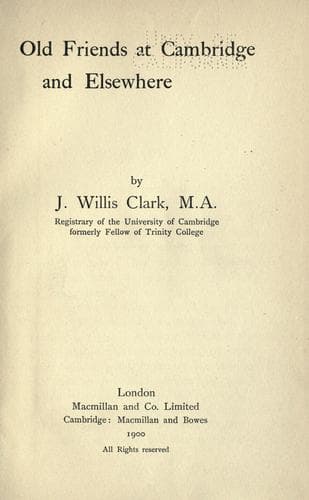
Old Friends at Cambridge and Elsewhere — John Shaqi
Old Friends at Cambridge and ElsewhereClark, John Willis
History
Old Friends at Cambridge and Elsewhere
Clark, John Willis
University of Cambridge -- History
‘It is a very sad evening of my College life, to have the College pulled
in pieces and ruined by a set of schoolboys. It is very nearly that kind
of work. The Act of Parliament gives all our Fellows equal weight for
certain purposes, and the younger part of them all vote the same way,
and against the Seniors. Several of these juveniles are really boys,
several others only Bachelors of Arts, so we have crazy work, as I think
it[13].’
As regards the University, as distinct from the College, he deserves
recognition as having effected important educational changes. These
range over the whole of his life, commencing with the novelties which he
introduced, in conjunction with Herschel, Peacock, and Babbage, into the
study of mathematics, so early as 1819. It was his constant endeavour,
whatever office he held—whether Moderator, Examiner, or College
lecturer—to keep the improvement and development of the Mathematical
Tripos constantly before the University. But, before we enumerate the
special improvements or developments with which he may be credited, let
us consider what was his leading idea. He held that every man who was
worth educating at all, had within him various faculties, such as the
mathematical, the philological, the critical, the poetical, and the
like; and that the truly liberal education was that which would develop
all of these, some more, some less, according to the individual nature.
A devotion to ‘favourite and selected pursuits’ was a proof, according
to him, of ‘effeminacy of mind.’ We are not sure that he would have been
prepared to introduce one or more classical papers into the Mathematical
Tripos, though he held that a mere mathematician was not an educated
man; but he was emphatic in wishing to preserve the provisions by which
classical men were obliged to pass certain mathematical examinations. He
did not want ‘_much_ mathematics’ from them, he said, writing to
Archdeacon Hare in 1842; ‘but a man who either cannot or will not
understand Euclid, is a man whom we lose nothing by not keeping among
us.’ He was no friend to examinations. He ‘repudiated emulation as the
sole spring of action in our education,’ but did not see his way to
reducing it. It was probably this feeling that made him object to
private tuition so strongly as he always did. In opposition to private
tutors, he wished to increase attendance at Professors’ lectures; and
succeeded in ‘connecting them with examinations,’ as he called it; in
other words, in making attendance at them compulsory for precisely those
men who were least capable of deriving benefit from the highest teaching
which the University can give, namely, the candidates for the Ordinary
Degree.
Public-domain text, read in full here on John Shaqi.
Reviews
Reviews
No reviews yet
Be the first to share your thoughts on this work.
Join the Discussion
Join the discussion
Sign in to leave a comment or review.
Sign InorCreate an account