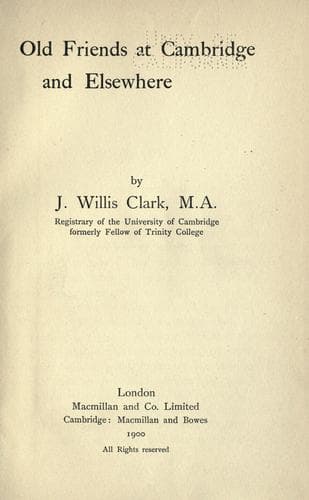
Old Friends at Cambridge and ElsewhereClark, John Willis
History
Old Friends at Cambridge and Elsewhere
Clark, John Willis
University of Cambridge -- History
‘Blessed beyond all blessings that life can embrace in its circle,
Blessed the gift was when Providence gave thee to me:
Gave thee, gentle and kindly and wise, calm, clear-seeing, thoughtful,
Thee to me as I was, vehement, passionate, blind:
Gave me to see in thee, and wonder I never had seen it,
Wisdom that shines in the heart dearer than Intellect’s light;
Gave me to find in thee, when oppressed by loneliness’ burden,
Solace for each dull pain, calm from the strife of the storm.
For O, vainly till then had I sought for peace and contentment,
Ever pursued by desires, yearnings that could not be still’d;
Ever pursued by desires of a heart’s companionship, ever
Yearning for guidance and love such as I found them in thee.’
It is painful to be obliged to record that Whewell’s executors found
that the copyright of his works had no mercantile value. He perhaps
formed a true estimate of his own powers when he said that all that he
could do was to ‘systematize portions of knowledge which the consent of
opinions has brought into readiness for such a process[14].’ His name
will not be associated with any great discovery, or any original theory,
if we except his memoir on Crystallography, which is the basis of the
system since adopted; and his researches on the Tides, which have
afforded a clear and satisfactory view of those of the Atlantic, while
it is hardly his fault if those of the Pacific were not elucidated with
equal clearness[15]. It too often happens that those who originally
suggest theories are forgotten in the credit due to those who develop
them; and we are afraid that this has been the fate of Whewell. Even as
a mathematician he is not considered really great by those competent to
form a judgment. He was too much wedded to the geometrical fashions of
his younger days, and ‘had no taste for the more refined methods of
modern analysis[16].’ In science, as in other matters, his strong
conservative bias stood in his way. He was constitutionally unable to
accept a thorough-going innovation. For instance, he withstood to the
last Lyell’s uniformity, and Darwin’s evolution[17]. Much, therefore, of
what he wrote will of necessity be soon forgotten; but we hope that some
readers may be found for his _Elements of Morality_, and that his great
work on the Inductive Sciences may hold its own. It is highly valued in
Germany; and in England Mr John Stuart Mill, one of the most cold and
severe of critics, who differed widely from Whewell in his scientific
views, has declared that ‘without the aid derived from the facts and
ideas contained in the _History of the Inductive Sciences_, the
corresponding portion of his own _System of Logic_ would probably not
have been written.’
Public-domain text, read in full here on John Shaqi.
Reviews
Reviews
No reviews yet
Be the first to share your thoughts on this work.
Join the Discussion
Join the discussion
Sign in to leave a comment or review.
Sign InorCreate an account