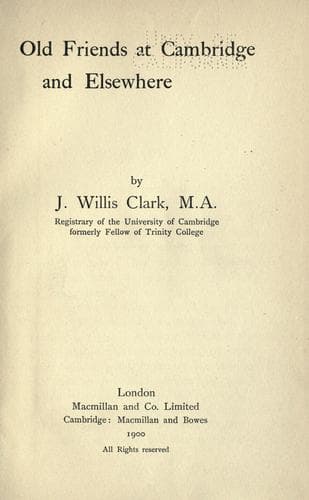
Old Friends at Cambridge and ElsewhereClark, John Willis
History
Old Friends at Cambridge and Elsewhere
Clark, John Willis
University of Cambridge -- History
We have felt it our duty to point out these shortcomings; but it is a
far more agreeable one to turn from them, and conclude our essay by
indicating the lofty tone of religious enthusiasm which runs through all
his works. As Dr Lightfoot pointed out in his funeral sermon, ‘the world
of matter without, the world of thought within, alike spoke to him of
the Eternal Creator the Beneficent Father; and even his opponent, Sir
David Brewster, who more strongly than all his other critics had
denounced what he termed the paradox advanced in _The Plurality of
Worlds_, that our earth may be ‘the oasis in the desert of the solar
system,’ was generous enough to admit that posterity would forgive the
author ‘on account of the noble sentiments, the lofty aspirations, and
the suggestions, almost divine, which mark his closing chapter on the
future of the universe.’
CONNOP THIRLWALL[18].
Until a few years ago biographies of Bishops were remarkable for that
decent dullness which Sydney Smith has noted as a characteristic of
modern sermons. The narrative reproduced, with painful fidelity, the
oppressive decorum and the conventional dignity; but kept out of sight
the real human being which even in the Georgian period must have existed
beneath official trappings. But in these matters, as in others, there is
a fashion. The narratives which describe the lives of modern Bishops
reflect the change that has come over the office. As now-a-days ‘a
Bishop’s efficiency is measured, in common estimation, by his power of
speech and motion[19],’ his biography, if he has overtopped his brethren
in administration, or eloquence, or statesmanship, becomes an
entertaining, and sometimes even a valuable, production. It reflects the
ever-changing incidents of a bustling career; it is spiced with good
stories; and it reveals, more or less indiscreetly, matters of high
policy in Church and State, over which a veil has hitherto been drawn.
In a word, it is the portrait of a real person, not of a lay figure:
and, if the artist be worthy of his task, a portrait which faithfully
reproduces the original. The life of Bishop Thirlwall could not have
been treated in quite the same way as the imaginary biography we have
just indicated; but, in good hands, it might have been made quite as
entertaining, and much more valuable. Dr Perowne has told us that his
life was not eventful. It was not, in the ordinary sense of that word.
He rarely quitted his peaceful retreat at Abergwili; but, paradoxical as
it sounds, he was no recluse. He took part in spirit, if not in bodily
presence, in all the important events, political, religious, and
literary, of his time; and when he chose to break silence, in speech or
pamphlet, no one could command a more undivided attention, or exercise a
more powerful influence.
Public-domain text, read in full here on John Shaqi.
Reviews
Reviews
No reviews yet
Be the first to share your thoughts on this work.
Join the Discussion
Join the discussion
Sign in to leave a comment or review.
Sign InorCreate an account