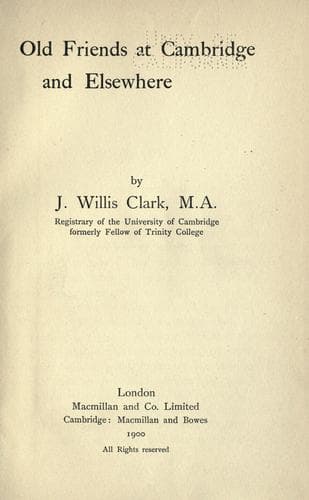
Old Friends at Cambridge and ElsewhereClark, John Willis
History
Old Friends at Cambridge and Elsewhere
Clark, John Willis
University of Cambridge -- History
We will quote a passage from one of these childish sermons, written when
he was eight years old. The text selected is, ‘Behold, I will add unto
thy days fifteen years’ (Isaiah xiii. 6); and, after some commonplaces
on the condition of Hezekiah, the author takes occasion from the day,
January 1, 1806, to make the following reflections:
‘I shall now consider what resolutions we ought to form at the beginning
of a new year. The intention of God in giving us life was that we might
live a life of righteousness. The same ever is His intention in
preserving it. We ought, then, to live in righteousness, and obey the
commandments of God. Do we not perceive that another year is come, that
time is passing away quickly, and eternity is approaching? and shall we
be all this while in a state of sin, without any recollection that the
kingdom of heaven is nearer at hand? But we ought, in the beginning of a
new year, to form a resolution to be more mindful of the great account
we must give at the last day, and live accordingly: we ought to form a
resolution to reform our lives, and walk in the ways of God’s
righteousness; to abhor all the lusts of the flesh, and to live in
temperance; and resolve no more to offend and provoke God with our sins,
but repent of them. In the beginning of a new year we should reflect a
little: although we are kept alive, yet many died in the course of last
year; and this ought to make us watchful[21].’
There is not much originality of thought in this; indeed, it is
impossible to avoid the suspicion that the paternal sermons, to which
the author doubtless listened every Sunday, suggested the form, and
possibly the matter, of these essays. What meaning could a child of
eight attach to such expressions as ‘the lusts of the flesh,’ or
‘repentance,’ or ‘eternity’? Still, notwithstanding this evident
imitation of others in the matter, the style has a remarkable
individuality. Indeed, just as the portrait of the child which is
prefixed to the volume recalls forcibly the features of the veteran
Bishop at seventy years of age, we fancy that we can detect in the style
a foreshadowing of some of the qualities which rendered that of the man
so remarkable. There is the same orderly arrangement of what he has to
say, the same absence of rhetoric, the same logical deduction of the
conclusion from the premisses. As we turn over the pages of the volume
we are struck by the extent of reading which the allusions suggest. The
best English authors, the most famous men of antiquity, are quoted as if
the writer were familiar with them. The themes, too, are singularly
varied. We find ‘An Eastern Tale,’ which, though redolent of _Rasselas_,
is not devoid of originality, and has considerable power of description;
an ‘Address’ delivered to the Worshipful Company of Drapers at their
annual visit to Bancroft’s School, which is not more fulsome than such
compositions usually are; and, lastly, half a dozen poems, which are by
far the best things in the book.
Public-domain text, read in full here on John Shaqi.
Reviews
Reviews
No reviews yet
Be the first to share your thoughts on this work.
Join the Discussion
Join the discussion
Sign in to leave a comment or review.
Sign InorCreate an account