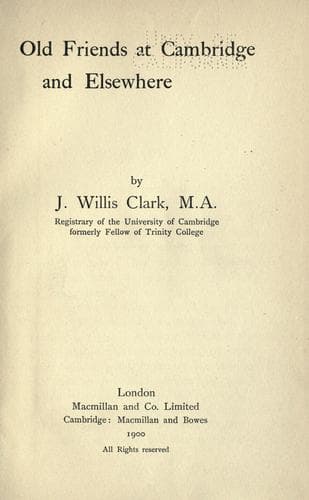
Old Friends at Cambridge and ElsewhereClark, John Willis
History
Old Friends at Cambridge and Elsewhere
Clark, John Willis
University of Cambridge -- History
What manner of man was this? By what system of education had his mind
been developed? What were his tastes, his pursuits, his daily life? To
these questions, which are surely not unreasonable, the editors of the
five volumes before us vouchsafe no adequate reply, for the meagre
thread of narrative which connects together the _Letters Literary and
Theological_, may be left out of consideration. Thirlwall’s life, as we
understand the word, has yet to be written; and we fear that death has
removed most of those who could perform the task in a manner worthy of
the subject. For ourselves, all that we propose to do is to try to set
forth his talents and his character, by the help of the materials before
us, and of such personal recollections as we have been able to gather
together.
Connop Thirlwall was born February 11, 1797. His father, the Rev. Thomas
Thirlwall, minister of Tavistock Chapel, Broad Court, Long Acre,
Lecturer of S. Dunstan, Stepney, and chaplain to the celebrated Thomas
Percy, Lord Bishop of Dromore, resided at Mile End. We can give no
information about him except the above list of his preferments; and of
Connop’s mother we only know that her husband describes her as ‘pious
and virtuous,’ and anxious to ‘promote the temporal and eternal welfare’
of her children. She had the satisfaction of living long enough to see
her son a bishop[20]. Connop must have been a fearfully precocious
child. In 1809 the fond father published a small duodecimo volume
entitled ‘_Primitiæ; or, Essays and Poems on Various Subjects,
Religious, Moral, and Entertaining_. By Connop Thirlwall, eleven years
of age.’ The first of these essays is dated ‘June 30, 1804. Seven years
old’; and in the preface the father says:
‘In the short sketch which I shall take of the young author, and his
performance, I mean not to amuse the reader with anecdotes of
extraordinary precocity of genius; it is, however, but justice to him to
state, that at a very _early_ period he read English so well that he was
taught Latin at three years of age, and at four read Greek with an ease
and fluency which astonished all who heard him. From that time he has
continued to improve himself in the knowledge of the Greek, Latin,
French, and English languages. His talent for composition appeared at
the age of seven, from an accidental circumstance. His mother, in my
absence, desired his elder brother to write his thoughts upon a subject
for his improvement, when the young author took it into his head to ask
her permission to take the pen in hand too. His request was of course
complied with, without the most remote idea he could write an
intelligible sentence, when in a short time he composed that which is
first printed, “On the Uncertainty of Life.” From that time he was
encouraged to cultivate a talent of which he gave so flattering a
promise, and generally on a Sunday chose a subject from Scripture. The
following essays are selected from these lucubrations.’
Public-domain text, read in full here on John Shaqi.
Reviews
Reviews
No reviews yet
Be the first to share your thoughts on this work.
Join the Discussion
Join the discussion
Sign in to leave a comment or review.
Sign InorCreate an account