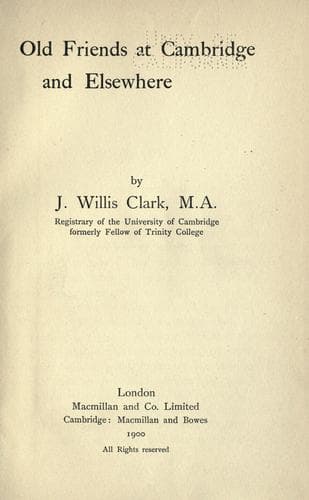
Old Friends at Cambridge and ElsewhereClark, John Willis
History
Old Friends at Cambridge and Elsewhere
Clark, John Willis
University of Cambridge -- History
‘I certainly was not made to sit at home in contented ignorance of the
wonders of art and nature, nor can I believe that the restlessness of
curiosity I feel was implanted in my disposition to be a source of
uneasiness rather than of enjoyment. Under this conviction I peruse the
authors of France and Italy, with the idea that the language I am now
reading I may one day be compelled to speak, and that what is now a
source of elegant and refined entertainment may be one day the medium
through which I shall disclose my wants and obtain a supply of the
necessaries of daily life. This is the most enchanting of my day dreams;
it has been for some years past my inseparable companion. And, apt as
are my inclinations to fluctuate, I cannot recollect this to have ever
undergone the slightest abatement[34].’
The letter from which we have selected the above passage was written to
his uncle in 1816; in another, written a few months later to his friend
Mr Candler, he enters more fully into his difficulties and prospects.
The earlier portion of the letter is well worth perusal for the insight
it affords into the extent of his reading and the originality of his
criticisms; but it is the concluding paragraph which is specially
interesting to a biographer. We do not know to what influences the
change was due, but it is evident that his mind was passing through a
period of unrest; his old determinations had been, at least for the
moment, uprooted, and he looked forward with uncertain eyes to an
unknown future. ‘My disinclination to the Church,’ he says, ‘has grown
from a motive into a reason.’ The Bar had evidently been suggested to
him as the only alternative, and on that dismal prospect he dilates with
unwonted bitterness. It would take him away from all the pursuits he
loved most dearly, and put in their place ‘the routine of a barren and
uninteresting occupation,’ in which not only would the best years of his
life be wasted, but—and this is what he seems to have dreaded most—his
loftier aspirations would be degraded, and, when he had become rich
enough to return to literature, he would feel no inclination to do so.
The Fellowship examination of 1818 having ended in Thirlwall’s election,
he was free to go abroad, and at once started alone for Rome. At that
time Niebuhr was Prussian Envoy there, and Bunsen his Secretary of
Legation. Thirlwall was so fortunate as to bring with him a letter of
introduction to Madame Bunsen, who had been a Miss Waddington, cousin to
Professor Monk, and had married Bunsen about a year before Thirlwall’s
visit. The following amusing letter from Madame Bunsen to her mother
gives an interesting picture of Thirlwall in Rome:
Public-domain text, read in full here on John Shaqi.
Reviews
Reviews
No reviews yet
Be the first to share your thoughts on this work.
Join the Discussion
Join the discussion
Sign in to leave a comment or review.
Sign InorCreate an account