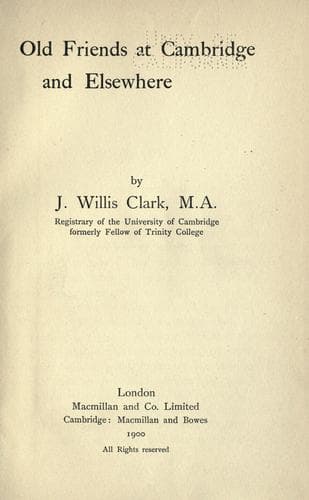
Old Friends at Cambridge and ElsewhereClark, John Willis
History
Old Friends at Cambridge and Elsewhere
Clark, John Willis
University of Cambridge -- History
‘_March 16, 1819._—Mr Hinds and Mr Thirlwall are here.... My mother has,
I know, sometimes suspected that a man’s abilities are to be judged of
in an _inverse ratio_ to his Cambridge honours; but I believe that rule
is really not without exception, for Mr Thirlwall is certainly no dunce,
although, as I have been informed, he attained high honours at Cambridge
at an earlier age than anybody except, I believe, Porson. In the course
of their first interview Charles heard enough from him to induce him to
believe that Mr Thirlwall had studied Greek and Hebrew in good earnest,
not merely for _prizes_; also, that he had read Mr Niebuhr’s Roman
History proved him to possess no trifling knowledge of German; and, as
he expressed a wish to improve himself in the language, Charles ventured
to invite him to come to us on a Tuesday evening, whenever he was not
otherwise engaged, seeing that many Germans were in the habit of calling
on that day. Mr Thirlwall has never missed any Tuesday evening since,
except the _moccoli_ night and one other when it rained dogs and cats.
He comes at eight o’clock, and never stirs to go away till everybody
else has wished good night, often at almost twelve o’clock. It is
impossible for any one to behave more like a man of sense and a
gentleman than he has always done—ready and eager to converse with
anybody that is at leisure to speak to him, but never looking fidgety
when by necessity left to himself; always seeming animated and
attentive, whether listening to music, or trying to make out what people
say in German, or looking at one of Goethe’s songs in the book, while it
is sung. And so there are a great many reasons for our being _very much_
pleased with Mr Thirlwall; yet I rather suspect him of being very cold,
and very dry; and although he seeks, and seeks with general success, to
understand everything, and in every possible way increase his stock of
ideas, I doubt the possibility of his understanding anything that is to
be _felt_ rather than _explained_, and that cannot be reduced to a
system. I was led to this result by some most extraordinary questions
that he asked Charles about _Faust_ (which he had borrowed of us, and
which he greatly admired nevertheless, attempting a translation of one
of my favourite passages, which, however, I had not pointed out to him
as being such), and also by his great fondness for the poems of
Wordsworth, two volumes of which he insisted on lending to Charles.
These books he accompanied with a note, in which he laid great stress
upon the necessity of reading the author’s _prose essays on his own
poems_, in order to be enabled to relish the latter. Yet Mr Thirlwall
speaks of Dante in a manner that would seem to prove a thorough taste
for his poetry, as well as that he has really and truly studied it; for
he said to me that he thought no person who had taken the trouble to
understand the whole of the _Divina Commedia_ would doubt about
Public-domain text, read in full here on John Shaqi.
Reviews
Reviews
No reviews yet
Be the first to share your thoughts on this work.
Join the Discussion
Join the discussion
Sign in to leave a comment or review.
Sign InorCreate an account