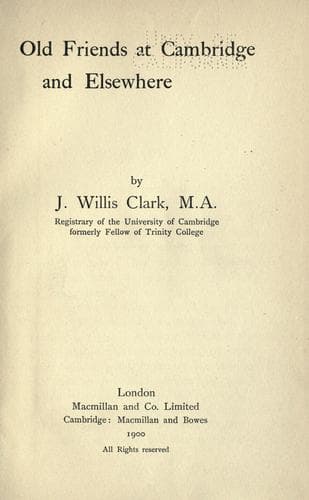
Old Friends at Cambridge and ElsewhereClark, John Willis
History
Old Friends at Cambridge and Elsewhere
Clark, John Willis
University of Cambridge -- History
‘On the other hand, intellectual labour prompted and directed by no
higher consideration than that of personal emolument appears to me to
deserve an ignominious name; nor do I think such an employment the less
illiberal, however great may be the abilities exerted, or the advantages
purchased. But I conceive such labour to become still more degrading,
when it is let out to serve the views and advocate the opinions of
others. It sinks another step lower in my estimation, when, instead of
being applied to communicate what is excellent and useful, it ministers
to the purpose of excluding from circulation all such intellectual
productions as have not been stampt with the seal of the party to which
it is itself subservient. But when I see it made the instrument of a
religious, political, or literary proscription, forging or pointing
calumny and slander to gratify the malice of hotter and weaker heads
against all whom they hate and fear, I have now before me an instance of
what I consider as the lowest and basest intellectual drudgery. I leave
the application of these distinctions to the QUARTERLY REVIEWER.’
In 1831 the two friends started the publication of the _Philological
Museum_. It had a brief but glorious career. Only six numbers were
published, but they contained ‘more solid additions to English
literature and scholarship’ than had up to that time appeared in any
journal. We are glad to see that seven of Thirlwall’s contributions have
been republished, and that among them is the well-known essay _On the
Irony of Sophocles_. Those who read these articles, and still more those
who turn to the volumes from which they have been extracted, and look
through the whole series of Thirlwall’s contributions, will be as much
impressed by the writer’s erudition as by his critical insight; and, if
a translation from the German should fall under their notice, they will
not fail to remark the extraordinary skill with which he has turned that
difficult language into sound English. Thirlwall would have smiled with
polite incredulity had any one told him that he was setting an example
in those writings of his which would bear fruit in years to come; but we
maintain that this is what really happened. More than one of his
successors in the field of classics at Cambridge was directly stimulated
by what he had done to undertake an equally wide course of reading; and
it may be argued with much probability that the thoroughness and breadth
of illustration with which classical subjects are treated by the
lecturers in Trinity College is derived from his initiative.
Public-domain text, read in full here on John Shaqi.
Reviews
Reviews
No reviews yet
Be the first to share your thoughts on this work.
Join the Discussion
Join the discussion
Sign in to leave a comment or review.
Sign InorCreate an account