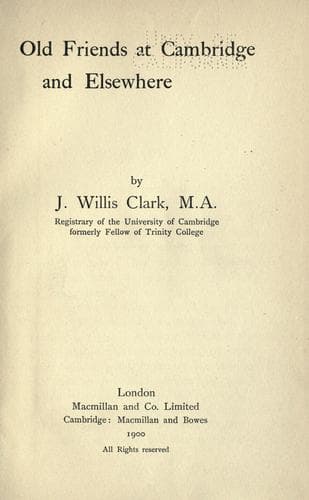
Old Friends at Cambridge and ElsewhereClark, John Willis
History
Old Friends at Cambridge and Elsewhere
Clark, John Willis
University of Cambridge -- History
which must have existed in all other matters between the passionate
Toryism of the one and the serene Liberalism of the other.
Thirlwall’s gallant attempt to follow an uncongenial profession could
have but one termination; and we can imagine his friends watching with
some curiosity for the moment and the cause of the final rupture. The
moment was probably determined by the prosaic consideration that his
fellowship at Trinity College would terminate in October 1828, unless he
were in Priest’s Orders. We do not mean that he became a clergyman in
order to secure a comfortable yearly income; but, that having decided in
favour of the clerical profession, joined to those literary pursuits
which his position as a fellow of Trinity College would allow, he took
the necessary steps in good time. He returned to Cambridge in 1827, and,
having been ordained deacon in the same year, and priest in the year
following, at once undertook his full share of college and University
work[44]. His friend Hare had set the example in 1822 by accepting a
classical lectureship at Trinity College at the urgent request of Mr
Whewell, then lately appointed to one of the tutorships[45], and
Thirlwall had paid visits to him in the Long Vacations of 1824 and 1825.
It is probable that at one of these visits the friends had planned their
translation of Niebuhr’s _History of Rome_, for the first volume was far
advanced in 1827, and was published early in 1828. The second did not
appear until 1832. The publication of what Thirlwall rightly terms ‘a
wonderful masterpiece of genius’ in an English dress marked an epoch in
historical and classical literature in this country. Yet,
notwithstanding its pre-eminent excellence, the work of the translators
was bitterly attacked in various places, and particularly in a note
appended to an article in the _Quarterly Review_, a criticism which
would long ago have been forgotten if it had not called forth a reply
which we have heard described as ‘Hare’s bark and Thirlwall’s bite[46].’
The pamphlet consists of sixty-three pages, of which sixty belong to the
former, and a ‘Postscript,’ of little more than two, to the latter. It
is probable that Hare’s elaborate vindication of his author, his brother
translator, and himself, had but little effect on any one; Thirlwall’s
indignant sarcasms—worthy of the best days of that controversial style
in which he subsequently became a master—are still remembered and
admired. We will quote a few sentences, of an application far wider than
the criticism to which they originally referred. The reviewer had
expressed pity that the translators should have wasted ‘such talents on
the drudgery of translation.’ Thirlwall took exception to the phrase,
and pointed out that their intellectual labour did not deserve to be so
spoken of.
Public-domain text, read in full here on John Shaqi.
Reviews
Reviews
No reviews yet
Be the first to share your thoughts on this work.
Join the Discussion
Join the discussion
Sign in to leave a comment or review.
Sign InorCreate an account