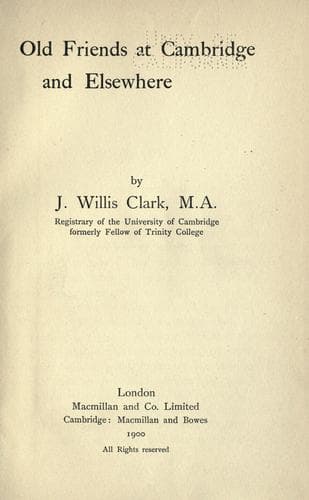
Old Friends at Cambridge and ElsewhereClark, John Willis
History
Old Friends at Cambridge and Elsewhere
Clark, John Willis
University of Cambridge -- History
In 1834 Thirlwall’s connection with the educational staff of the college
was rudely severed by a controversy respecting the admission of
Dissenters to degrees. This debate has been long since forgotten in the
University; but the influence which it exercised on Thirlwall’s future
career, as well as its own intrinsic interest, point it out for
particular notice. We had occasion in a recent article[47] to sketch the
changes which took place in the University between 1815 and 1830. It
will be remembered that the stormy period of our political history which
is associated with the first Reform Bill fell between those dates. It
was hardly to be expected that Cambridge should escape an influence by
which the country was so profoundly affected. Indeed, it may be cited as
a sign of the absorbing interest of that question, that it did affect
the University very seriously; for there is ample evidence that in the
previous century external events, no matter how important, had made but
little impression. In 1746 we find the poet Gray lamenting that his
fellow academicians were so indifferent to the march of the Pretender;
and even the French Revolution excited but a languid enthusiasm, though
Dr Milner, the Vice-Chancellor, and his brother Heads, did their best to
draw attention to it by expelling from the University Mr Frend, of Jesus
College, for writing a pamphlet called _Peace and Union_, which
advocated the principles of its leaders. With the Reform Bill of 1830,
however, the case was very different. Sides were eagerly taken;
discussions grew hot and angry; old friends became estranged; and, years
afterwards, when children of the next generation asked questions of
their parents about some one whose name was mentioned in their hearing,
but with whom they were not personally acquainted, it was not unusual
for them to be told: ‘That is Mr So-and-so; he used to be very intimate
with us before the Reform Bill; but we never speak now.’
Public-domain text, read in full here on John Shaqi.
Reviews
Reviews
No reviews yet
Be the first to share your thoughts on this work.
Join the Discussion
Join the discussion
Sign in to leave a comment or review.
Sign InorCreate an account