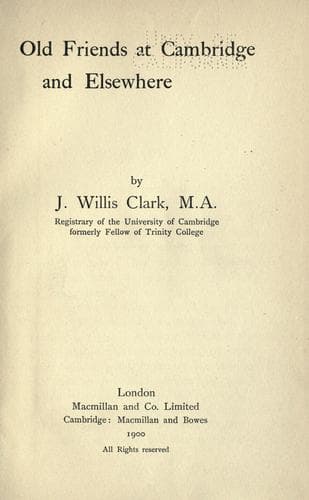
Old Friends at Cambridge and ElsewhereClark, John Willis
History
Old Friends at Cambridge and Elsewhere
Clark, John Willis
University of Cambridge -- History
One of the grievances then discussed was the exclusion of Dissenters
from participation in the advantages of the Universities. The propriety
of imposing tests at matriculation, and on proceeding to degrees,
especially to degrees in the faculties of law and physic, had been from
time to time debated, both in the University and in the House of
Commons. The ancient practice had, notwithstanding, been steadily
maintained. On one occasion, in 1772, the House had even gone so far as
to decline, by a majority of 146, to receive a petition on the subject.
In December 1833, however, Professor Pryme offered Graces to the Senate
for appointing a Syndicate to consider the abolition or the modification
of subscription on graduation. The ‘Caput[48]’ rejected them. In
February of the following year, Dr Cornwallis Hewett, Downing Professor
of Medicine, offered a similar Grace to consider the subject with
special reference to the faculty of medicine. This also was rejected by
the ‘Caput’ on the veto of the Vice-Chancellor, Dr King, President of
Queens’ College. These two rejections, following so closely upon each
other, made it evident that the authorities of the University were not
disposed so much as to consider the subject. It was therefore determined
to extend the field of the controversy, and at once to apply to the
Legislature. A meeting was held at Professor Hewett’s rooms in Downing
College, at which it was agreed to present an identical petition to both
Houses of Parliament. The document began by stating the attachment of
the petitioners to the Church of England, and to the University as
connected therewith; and further, their belief ‘that no civil or
ecclesiastical polity was ever so devised by the wisdom of man as not to
require, from time to time, some modification from the change of
external circumstances or the progress of opinion.’ They then
suggested—this was the word employed—
‘“That no corporate body, like the University of Cambridge, can exist in
a free country in honour and safety unless its benefits be communicated
to all classes as widely as may be compatible with the Christian
principles of its foundation”; and urged “the expediency of abrogating
by legislative enactment every religious test exacted from members of
the University before they proceed to degrees, whether of Bachelor,
Master, or Doctor, in Arts, Law, or Physic.”’
Public-domain text, read in full here on John Shaqi.
Reviews
Reviews
No reviews yet
Be the first to share your thoughts on this work.
Join the Discussion
Join the discussion
Sign in to leave a comment or review.
Sign InorCreate an account