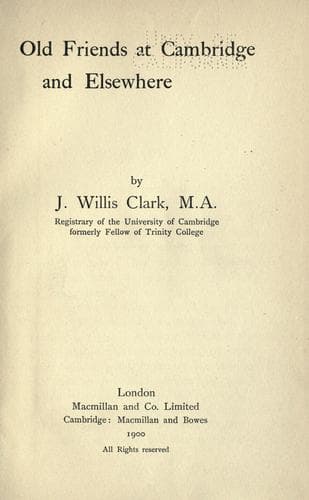
Old Friends at Cambridge and ElsewhereClark, John Willis
History
Old Friends at Cambridge and Elsewhere
Clark, John Willis
University of Cambridge -- History
University life changes with such rapidity, that no matter how great a
man may have been, it is inevitable that he should soon become little
more than a tradition to those who succeed him. Few of the present
Fellows of Trinity College can have even seen Dr Whewell; and though his
outward appearance has been handed down to posterity by a picture in the
Lodge, a bust in the Library, and a statue in the Chapel, neither canvas
nor marble, no matter how skilfully they may be handled, can convey the
impression which that king of men made upon his contemporaries. These
portraits give a fairly just idea of his lofty stature, broad shoulders,
and large limbs, but the features are inadequately rendered in all of
them. The proportions are probably correct, but the expression has been
lost. The artists have been so anxious to render the philosopher, that
they have forgotten the man. His expression, except on very solemn
occasions, was never so grave as they have made it. His bright blue eye
had nearly always a merry twinkle in it, and his broad mouth was ever
ready to break into a smile. His nature was essentially joyous; and he
dearly loved a good joke, a funny story, or a merry party of friends, in
which his laugh was always the loudest, and his pleasure the keenest.
Nor did he disdain the pleasures of the table; a good dinner, followed
by a good bottle of port, was not without its charm for him, though it
may be doubted whether he enjoyed these matters for their own sake so
much as for the society they brought with them. He could not bear to be
alone, and was not particular into what company he went, provided he
could get good conversation, and plenty of it. He used to say that he
liked to hear a dinner in ‘full cry’; and, if we may adopt his own
simile without offence to the memory of one whom we love and revere, he
was himself the leader of the pack. He could hardly be called a good
talker; he was too fond of the sound of his own loud cheery voice, and
engrossed the conversation too much. He would take up a subject started
by somebody else, and handle it in a masterly fashion, as if he were in
a lecture room, while the rest sat by and listened. He laid down the
law, too, in a style that did not admit of reply. We remember an
occasion when the conversation turned on Longfellow’s _Golden Legend_,
then just published, and Whewell was asked to say what he thought of it.
‘I think it is a bad echo of a bad original, Goethe’s _Faust_,’
thundered out the great man; after which, of course, there was a dead
silence. Again, he was no respecter of persons, nor was he too careful
to observe the ordinary rules of politeness. If anybody said a silly
thing, even if the person were a lady, and in her own house, he thought
nothing of crushing her with ‘Madam, no one but a fool would have made
that observation’; but his company was so delightful, his stores of
information so varied and so vast, his readiness to communicate them so
Public-domain text, read in full here on John Shaqi.
Reviews
Reviews
No reviews yet
Be the first to share your thoughts on this work.
Join the Discussion
Join the discussion
Sign in to leave a comment or review.
Sign InorCreate an account