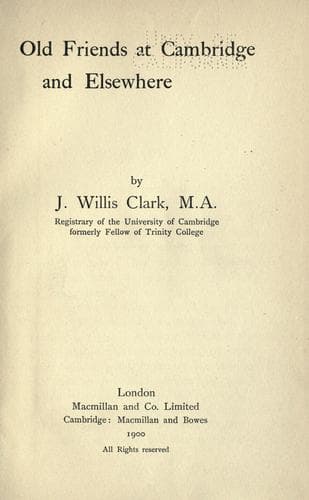
Old Friends at Cambridge and ElsewhereClark, John Willis
History
Old Friends at Cambridge and Elsewhere
Clark, John Willis
University of Cambridge -- History
unusual, and his memory so retentive, that these eccentricities in
‘Rough Diamond,’ as a clever University _jeu d’esprit_ called him, were
readily forgiven. He was far too well aware of his own supremacy to be
afraid of unbending; and years after he became Master of Trinity he has
been seen to kneel down on the carpet to play with a Skye terrier. He
was a special favourite with young people, especially with young ladies,
from the heartiness with which he threw himself into their pursuits and
pleasures, talked with them, romped with them, wrote verses and riddles
and translated German poems for their amusement, and assisted
approvingly at the musical parties which were the fashion when he was a
young man. There were indeed several houses in Cambridge and its
neighbourhood in which we should have ventured to say that he was ‘a
tame cat,’ had there been anything feline in that rugged and vehement
nature.
Those who wish to draw for themselves a life-like portrait of Whewell in
his best days must take into account the fact that his health was always
excellent. There is a legend that as a boy he was delicate; but, if this
were ever the case, which we doubt, he put it aside with other childish
things. When he came to man’s estate no rebellious liver ever troubled
his repose, or made him look upon life with a jaundiced eye. It was his
habit to sit up late; but, notwithstanding, he appeared regularly at
morning chapel, then at 7 a.m., fresh and radiant, and ready for the
day’s work. This vigour of body enabled him to appreciate everything
with a keenness which age could not dull, nor the most poignant grief
extinguish, except for very brief intervals. He thoroughly appreciated
‘the mere joy of living’; and whatever was going forward attracted him
so powerfully that he was never satisfied until he had found out all
about it. He went everywhere: to public ceremonials and exhibitions; to
new plays, new music, new pictures; to London drawing-rooms and smart
country houses; to quiet parsonages and canonical residences; to foreign
cities and English cathedrals; always deriving the keenest enjoyment
from what he saw, and delighting in new experiences because they were
new. There was but one exception to the universality of his interests.
When he was a resident Fellow of Trinity, it was the fashion for College
Dons to dabble in politics, and more than one of his Trinity friends
made their fortune by their Liberal opinions. He did not imitate their
example. He always described himself as no politician. As a young man he
seemed inclined to take a Liberal line, for he opposed a petition from
the University against the Roman Catholic claims in 1821, and in the
following year voted against ‘our dear, our Protestant Bankes’ for the
same reason. But in those stormy days of the Reform Bill, when so many
ancient friendships were destroyed, he took no decided line; and
latterly he abstained from politics altogether. We do not mean that he
Public-domain text, read in full here on John Shaqi.
Reviews
Reviews
No reviews yet
Be the first to share your thoughts on this work.
Join the Discussion
Join the discussion
Sign in to leave a comment or review.
Sign InorCreate an account