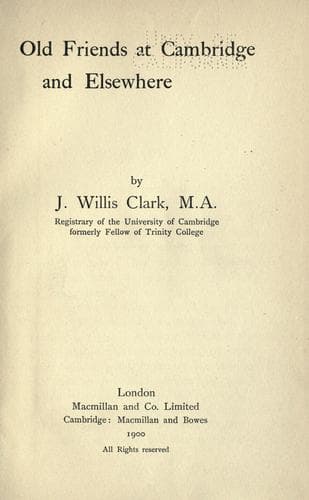
Old Friends at Cambridge and Elsewhere — John Shaqi
Old Friends at Cambridge and ElsewhereClark, John Willis
History
Old Friends at Cambridge and Elsewhere
Clark, John Willis
University of Cambridge -- History
Whewell came up to Cambridge at the beginning of the Michaelmas
Term, 1812. Those who are familiar with the exciting spectacle
presented by the splendid intellectual activity of the Cambridge of
to-day—accommodating itself with flexibility and readiness to
requirements the most diverse, appointing new teachers in
departments of study the most unusual and the most remote on the
bare chance of their services being required, flinging open its
doors to all comers, regardless of sex, creed, or nationality, and
thronged with students whose numbers are increasing year by year,
eager to take advantage of the instruction which their elders are
equally eager to supply them with—will find it difficult, if not
impossible, to imagine the totally different state of things which
existed at that time. Were we asked to express its characteristic by
a single word, we should answer, dulness. It must be remembered that
communication in those days was slow; news did not arrive until it
was stale; travelling, especially for passengers, was expensive, so
that, at least for the shorter vacations, many persons did not leave
Cambridge at all; and some remained there during the whole year—we
might say, in some cases, during their whole lives. For the same
reasons strangers rarely visited the University. The same people
dined and supped together day after day, with no novelty to
diversify their lives or their conversation. No wonder that they
became narrow, prejudiced, eccentric, or that their habits were
tainted with the grosser vices which there was no public opinion to
repudiate. The undergraduates, most of whom came from the upper
classes, were few. In the fifteen years between 1800 and 1815 the
yearly average of those who matriculated did not exceed 205: less
than one-fourth of those who now present themselves[2]. The only
road to the Honour Degree was through the Mathematical Tripos. The
amusements were as little varied as the studies. There was riding
for those who could afford it; and a few boated and played cricket
or tennis; but the majority contented themselves with a walk. With
the undergraduates, as with their seniors, the habit of hard
drinking was unfortunately still prevalent. But the great changes
through which the country passed between 1815 and 1834 produced a
totally different state of things. The old order changed; slowly and
almost imperceptibly at first, but still it changed. As the wealth
of the country increased, a new class of students presented
themselves for education; ideas began to circulate with rapidity;
old forms of procedure and examination were given up; academic
society was purified from its coarseness and vulgarity, and lost
much of its exclusiveness; new studies were admitted upon an all but
equal footing with the old ones; and, lastly, the new political
principles asserted themselves by gradually sweeping away, one after
another, all restrictive enactments. This last change, however, was
not consummated until 1871.
Public-domain text, read in full here on John Shaqi.
Reviews
Reviews
No reviews yet
Be the first to share your thoughts on this work.
Join the Discussion
Join the discussion
Sign in to leave a comment or review.
Sign InorCreate an account