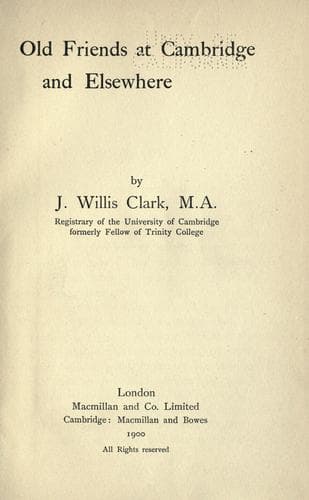
Old Friends at Cambridge and ElsewhereClark, John Willis
History
Old Friends at Cambridge and Elsewhere
Clark, John Willis
University of Cambridge -- History
shut his eyes to what was going forward in the world—far from it, but he
seemed to consider that one Administration was as good as another, and
provided no violent change was threatened, he left the destinies of the
Empire to take care of themselves. As he grew older, his mind became
engrossed by thoughts of the suffering which even the most glorious
achievements must of necessity entail. The events of the Indian Mutiny,
for instance, were followed by him with the closest interest; but he was
more frequently heard to deplore the severity dealt out to the natives
than to admire the heroism of their victims.
Whewell’s natural good health was no doubt maintained by his love of
open air exercise. No matter how busy he was, or how bad the weather, he
rarely missed his daily ride. On most afternoons he might be seen on his
grey horse ‘Twilight,’ usually with his inseparable friend Dr Worsley,
either galloping across country, or joining quieter parties along the
roads. He was never a good rider, but a very bold one, as will be seen
from the following story, the accuracy of which we once tested by
reference to Sebright, the veteran huntsman of the Fitzwilliam hounds.
Whewell was staying with Viscount Milton, we believe in 1828. One
morning his host said to him at breakfast, ‘We are all going out
hunting; what would you like to do?’ He replied, ‘I have never been out
hunting, and I should like to go too.’ So he was mounted on a first-rate
horse, well up to his weight, and told to keep close to the huntsman.
Whewell did as he was bid, and followed him over everything. They had an
unusually good run across a difficult country, in the course of which
Sebright took an especially stout and high fence. Looking round to see
what had become of the stranger, he found him at his side, safe and
sound. ‘That, sir, was a rasper,’ he said. ‘I did not observe that it
was anything more than ordinary,’ replied Whewell. So on they went, till
at last his horse pulled up, quite exhausted, to Whewell’s great
indignation, who exclaimed, ‘I thought a hunter never stopped.’
We are not presumptuous enough to suppose that we can add any new facts
to those which have been already collected in the volumes before us; but
we think that even after their publication there is room for a short
essay, which shall bring into prominence certain points in Whewell’s
academic career, and attempt to determine the value of what he did for
science in general, and for his own College and University in
particular. His life divides itself naturally into three periods of
about equal length, the first extending from his birth in 1794 to his
appointment as assistant-tutor of Trinity College in 1818, the second
from 1818 to his appointment as Master in 1841, and the third from 1841
to his death in 1866.
Public-domain text, read in full here on John Shaqi.
Reviews
Reviews
No reviews yet
Be the first to share your thoughts on this work.
Join the Discussion
Join the discussion
Sign in to leave a comment or review.
Sign InorCreate an account