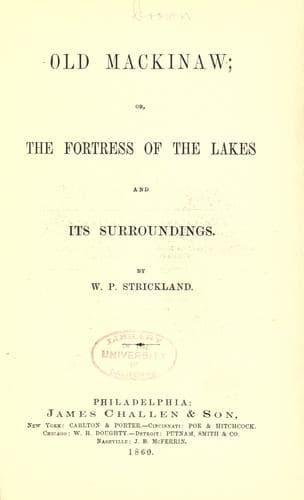
Old Mackinaw; Or, The Fortress of the Lakes and its SurroundingsStrickland, W. P. (William Peter)
History
Old Mackinaw; Or, The Fortress of the Lakes and its Surroundings
Strickland, W. P. (William Peter)
Great Lakes (North America); Mackinac Island (Mich. : Island) -- History; Michigan -- History
The demands of the Indians upon the English, and their dissatisfaction
arising therefrom, had the effect to rouse the different tribes, and
they were noticed assembling from the surrounding country in great
numbers, and gathering in the vicinity of Mackinaw. One night four
hundred Indians lay around the Fort, evidently plotting mischief. A
Chippewa chief apprised Henry of the impending danger; but when the
suspicions were communicated to the Commandant of the Fort, Major
Etherington, he took no notice of it, supposing that the Indians only
resorted to this for the purpose of intimidation. The next day being
the King's birthday, the Indians proposed to celebrate it by a game of
_baggatiway_. It was played with bat and ball, and the contestants
were the Chippewas and Sacs. Major Etherington was present at the
game, and bet largely on the side of the Chippewas. In the midst of
the game, when all were in a high state of excitement, a warrior
struck the ball and sent it whizzing over the palisade into the Fort.
Instantly the Indian war yell was heard, and the savages rushed within
the gate, not however for the ball, but to tomahawk and scalp every
Englishman within the Fort. The French stood by as silent spectators
of the bloody scene, and were not attacked.
Henry witnessed the dreadful slaughter from his window, and being
unarmed he hastened out, and springing over a low fence which divided
his house from that of M. Langlade, the French Interpreter, entered
the latter, and requested some one to direct him to a place of safety.
Langlade hearing the request, replied that he could do nothing for
him. At that moment a slave belonging to Langlade, of the Pawnee tribe
of Indians, took him to a door which she opened, and informed him that
it led to the garret where he might conceal himself. She then locked
the door and took away the key. Through a hole in the wall Henry could
have a complete view of the Fort. He beheld the heaps of the slain,
and heard the savage yells, until the last victim was dispatched.
Having finished the work of death in the Fort, the Indians went out to
search the houses. Some Indians entered Langlade's house and asked if
there were any Englishmen concealed in it. He replied that he did not
know, they might search for themselves. At length they opened the
garret door and ascended the stairs, but Henry had concealed himself
among a heap of birch-bark vessels, which had been used in making
maple sugar, and thus escaped. Fatigued and exhausted, he lay down on
a mat and went to sleep, and while in this condition he was surprised
by the wife of Langlade, who remarked that the Indians had killed all
the English, but she hoped he might escape. Fearing, however, that she
would fall a prey to their vengeance if it was found that an
Englishman was concealed in her house, she at length revealed the
place of Henry's concealment, giving as a reason therefor, that if he
should be found her children would be destroyed. Unlocking the door,
Public-domain text, read in full here on John Shaqi.
Reviews
Reviews
No reviews yet
Be the first to share your thoughts on this work.
Join the Discussion
Join the discussion
Sign in to leave a comment or review.
Sign InorCreate an account