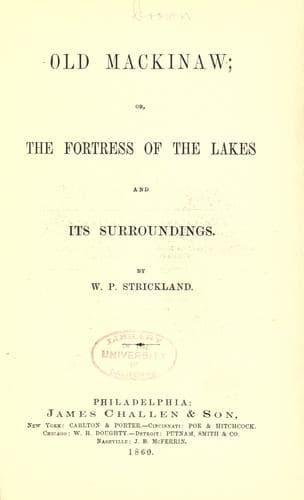
Old Mackinaw; Or, The Fortress of the Lakes and its SurroundingsStrickland, W. P. (William Peter)
History
Old Mackinaw; Or, The Fortress of the Lakes and its Surroundings
Strickland, W. P. (William Peter)
Great Lakes (North America); Mackinac Island (Mich. : Island) -- History; Michigan -- History
she was followed by several Indians, who were led by Wenniway, a noted
chief. At sight of him the chief seized him with one hand, and
brandishing a large carving knife, was about to plunge it into his
heart, when he dropped his arm, saying, "I won't kill you. My brother,
Musinigon, was slain by the English, and you shall take his place and
be called after him." He was carried to L'Arbre Croche as a prisoner,
where he was rescued by a band of three hundred Ottawas, by whom he
was returned to Mackinaw, and finally ransomed by his Indian friend
Wawatam. At the capture of the place only one trader, M. Tracy, lost
his life. Captain Etherington was carried away by some Indians from
the scene of slaughter. Seventy of the English troops were slain. An
Englishman, by the name of Solomon, saved himself by hiding under a
heap of corn, and his boy was saved by creeping up a chimney, where he
remained two days. A number of canoes, filled with English traders,
arriving soon after the massacre, they were seized, and the traders,
dragged through the water, were beaten and marched by the Indians to
the prison lodge. After they had completed the work of destruction,
the Indians, about four hundred in number, entertaining apprehensions
that they would be attacked by the English, and the Indians who had
joined them, took refuge on the Island of Mackinac, Wawatam fearing
that Henry would be butchered by the savages in their drunken revels,
took him out to a cave, where he lay concealed for one night on a heap
of human bones. As the Fort was not destroyed, it was subsequently
reoccupied by British soldiers, and the removal to the Island did not
take place until about the year 1780.
Old Mackinaw, the theatre of so many thrilling scenes and tragic
incidents, has a history as a white settlement, reaching back to 1620,
the year of the landing of the Pilgrims at Plymouth. W. M. Johnson,
Esq., of Mackinac Island, in describing its history, says: "Mackinaw
City," for such has become the name of this wonderful point, "with
its coasts and the islands before it, has been the theatre of some of
the most exciting and interesting events in Indian history, previous
to the arrival of the 'white man.' It was the metropolis of a portion
of the Ojibwa and Ottawa nations. It was there that their Congresses
met, to adopt a policy which terminated in the conquest of the country
south of it; it was there that the tramping feet of thousands of
plumed and painted warriors shook Pe-quod-e-nonge--the Indian
name--while dancing their war dances, it was from thence that the
startling sound of the war yell of these thousands was wafted to the
adjacent coast and islands, making the peaceful welkin ring with their
unearthly shouts of victory or death.
Public-domain text, read in full here on John Shaqi.
Reviews
Reviews
No reviews yet
Be the first to share your thoughts on this work.
Join the Discussion
Join the discussion
Sign in to leave a comment or review.
Sign InorCreate an account