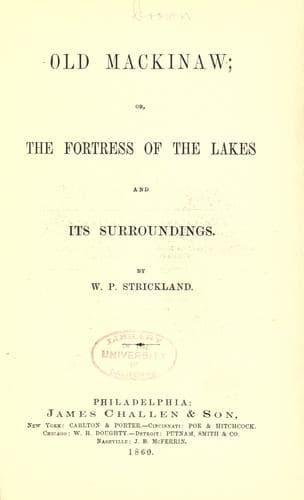
Old Mackinaw; Or, The Fortress of the Lakes and its SurroundingsStrickland, W. P. (William Peter)
History
Old Mackinaw; Or, The Fortress of the Lakes and its Surroundings
Strickland, W. P. (William Peter)
Great Lakes (North America); Mackinac Island (Mich. : Island) -- History; Michigan -- History
Robinson's Folly is a high bluff, northeast from the village of
Mackinaw, half a mile from the mission house. Soon after the
settlement of the modern Mackinaw, Capt. Robinson, of the English
army, then commanding this port, had a summer house built on the brow
of this bluff, now called Robinson's Folly, for the purpose of
enjoying the prospect from that cool and elevated spot. Often he and
his brother officers resorted there during the summer days, to while
away lonely and tedious hours. Pipes, cigars, and wine, were brought
into requisition. No Englishman at that period was without them; in
fact, no hospitality or entertainment was complete without them. They
were indeed isolated; the nearest white settlements being then
Detroit, Green Bay, Saut St. Mary, and Chicago. Communications with
these places were not frequent.
A few years after, from the action of the elements, the brow of the
bluff, where Robinson's Folly stood, was precipitated to the base of
the rock, where the fragments can now be seen, which disastrous event
gave rise to its name.
The "Scull Rock," half a mile or three quarters northwest from the
rear of Fort Mackinaw, is chiefly noted for a cavern, which appears to
have been a receptacle for human bones, many of which were still to be
observed about its mouth a few years ago. The entrance is low and
narrow, and seems to promise little to reward the labors of
exploration. It is here probably that Alexander Henry was secreted by
the chief Wawatam after the horrid massacre of the British garrison at
Old Mackinaw.
Chimney Rock well repays the trouble of a visit, with the other points
of interest on the island.
Dousman's Farm, two miles west from the Village of Mackinaw, consists
of a section of land; the road to the English or British landing
passes through it, also to Scott's or Flinn's Cave, which is on the
northwestern portion of the farm. There are three springs of cold
delicious water on this farm, two of them are shaded by beech and
maple trees. This farm yields yearly from eighty to one hundred tons
of hay, besides a large quantity of potatoes and other farm produce.
Public-domain text, read in full here on John Shaqi.
Reviews
Reviews
No reviews yet
Be the first to share your thoughts on this work.
Join the Discussion
Join the discussion
Sign in to leave a comment or review.
Sign InorCreate an account