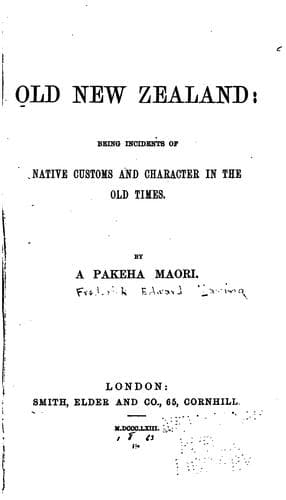
Old New Zealand: Being Incidents of Native Customs and Character in the Old TimesManing, Frederick Edward
History
Old New Zealand: Being Incidents of Native Customs and Character in the Old Times
Maning, Frederick Edward
Māori (New Zealand people); New Zealand -- Description and travel
I belong to both parties, and I don't care a straw which wins; but I am
sure we shall have fighting. Men _must_ fight; or else what are they
made for? Twenty years ago, when I heard military men talking of
"marching through New Zealand with fifty men," I was called a fool
because I said they could not do it with five hundred. Now I am also
thought foolish by civilians, because I say we can conquer New Zealand
with our present available means, if we set the right way about it
(which we won't). So hurrah again for the Maori! We shall drive the
pakeha into the sea, and send the Law after them! If we can do it, we
are right; and if the pakeha beat us, _they_ will be right too. God
save the Queen!
So now, my Maori tribe, and also my pakeha countrymen, I shall conclude
this book with good advice; and be sure you take notice: it is given to
both parties. It is a sentence from the last speech of old "Lizard
Skin." It is to you both. "Be brave, that you may live."
VERBUM SAPIENTI.
GLOSSARY.
_A pakeha tutua_--A mean, _poor_ European.--p. 18.
_Bare Motiti_--The Island of Motiti is often called "_Motiti wahie
kore_," as descriptive of the want of timber, or bareness of the
island. A more fiercely contested battle, perhaps, was never fought
than that on Motiti, in which the Ngati Kuri were destroyed.--p. 153.
_E aha te pai?_--What is the good (or use) of him? Said in
contempt.--p. 18.
_Haere mai! &c._--Sufficiently explained as the native call of welcome.
It is literally an invitation to advance.--p. 14.
_Hahunga_--A _hahunga_ was a funeral ceremony, at which the natives
usually assembled in great numbers, and during which "baked meats" were
disposed of with far less economy than Hamlet gives us to suppose was
observed "in Denmark."--p. 13.
_Jacky-poto_--Short Jack; or stumpy Jack.--p. 152.
_Kainga_--A native town, or village: their principal headquarters.--p.
13.
_Kia kotahi ki te ao! Kia kotahi ki te po!_--A close translation would
not give the meaning to the English reader. By these words the dying
person is conjured to cling to life, but as they are never spoken until
the person to whom they are addressed is actually expiring, they seemed
to me to contain a horrid mockery, though to the native they no doubt
appear the promptings of an affectionate and anxious solicitude. They
are also supposed to contain a certain mystical meaning.--p. 200.
Public-domain text, read in full here on John Shaqi.
Reviews
Reviews
No reviews yet
Be the first to share your thoughts on this work.
Elsewhere in the archive
Join the Discussion
Join the discussion
Sign in to leave a comment or review.
Sign InorCreate an account