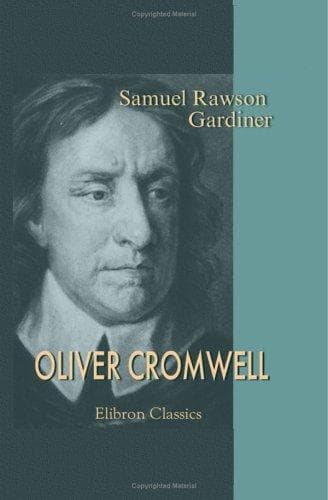
Cromwell, Oliver, 1599-1658; Great Britain -- History -- Commonwealth and Protectorate, 1649-1660
accession would have taxed the strength of any man, seeing how
unprepared was the England of that day to admit the possibility of
toleration. The pity of it was that Charles, with all his fine feelings
and conscientious rectitude, was unfitted for the task. Abandoning
himself heart and soul to the newly risen tide of religious thought,
his imagination was too weak to enable him to realise the strength
of Puritanism, so that he bent his energies, not to securing for his
friends free scope for the exercise of what persuasion was in them, but
for the repression of those whom he looked upon as the enemies of the
Church and the Crown. With the assistance of Laud he did everything in
his power to crush Puritanism, with the result of making Puritanism
stronger than it had been before. Every man of independent mind who
revolted against the petty interference exercised by Laud placed
himself by sympathy, if not by perfect conviction, in the Puritan ranks.
Neither in Elizabeth's nor in Charles's reign was it possible
to dissociate politics from religion. Parliament, dissatisfied
with Charles's ineffectual guidance of the State, was still more
dissatisfied with his attempt to use his authority over the Church to
the profit of an unpopular party. The House of Commons representing
mainly that section of the population in which Puritanism was the
strongest--the country gentlemen in touch with the middle-class in
the towns--was eager to pull down Laud's system in the Church, and to
hinder the extension of Royal authority in the State. To do this it was
necessary not only to diminish the power of the Crown, but to transfer
much of it to Parliament, which, at least in the eyes of its members,
was far more capable of governing England wisely.
That Cromwell heartily accepted this view of the situation is evident
from his being selected to move the second reading of the Bill for the
revival of annual Parliaments, which, by a subsequent compromise, was
ultimately converted into a Triennial Act ordaining that there should
never again be an intermission of Parliament for more than three years.
The fact that he was placed on no less than eighteen committees in
the early part of the sittings of the Parliaments shows that he had
acquired a position which he could never have reached merely through
his cousinship with Hampden and St. John. That he concurred in the
destruction of the special courts which had fortified the Crown in the
Tudor period, and in the prosecution of Strafford, needs no evidence to
prove. These were the acts of the House as a whole. It was the part he
took on those ecclesiastical questions which divided the House into two
antagonistic parties which is most significant of his position at this
time.
Public-domain text, read in full here on John Shaqi.
Reviews
Reviews
No reviews yet
Be the first to share your thoughts on this work.
Join the Discussion
Join the discussion
Sign in to leave a comment or review.
Sign InorCreate an account