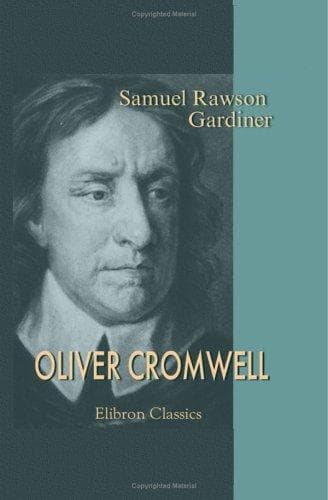
Cromwell, Oliver, 1599-1658; Great Britain -- History -- Commonwealth and Protectorate, 1649-1660
The hall of meeting was soon cleared. Harrison handed Speaker Lenthall
down from the chair. Algernon Sidney had to be removed with some show
of compulsion. Most of the members yielding to the inevitable trooped
out without even this nominal resistance. "It's you," said Cromwell as
they filed past him, "that have forced me to this, for I have sought
the Lord night and day that He would rather slay me than put me upon
the doing of this work." Glancing at the mace he asked "What shall
we do with this bauble?" Ordering Captain Scott to remove it from
the table, he bade him take it away. When all was over, carrying the
Bill on Elections under his cloak, he returned to Whitehall. In the
afternoon he dispersed--in like manner--the Council of State, assuring
its members that they could sit no longer, the Parliament having been
dissolved. "Sir," replied Bradshaw, "we have heard what you did at the
House in the morning, and before many hours all England will hear it;
but, Sir, you are mistaken to think that the Parliament is dissolved;
for no power under heaven can dissolve them but themselves; therefore
take you notice of that."
CHAPTER V.
THE NOMINATED PARLIAMENT AND THE PROTECTORATE.
As at the trial of the King, so in the ejection of Parliament,
Cromwell had been thrown back on the employment of military force.
Legality was clearly against him on both occasions. Yet it must not
be forgotten that he was the last to concur in the employment of
force; and that there was much to be said for his assertion that the
sitting members were no Parliament. Reduced by the flight of Royalists
to the King in 1642 and by Pride's Purge in 1648, they had, after an
existence of twelve years and a half, little remaining to them of that
representative character which is the very being of a Parliament. At
all events, this time, at least, Cromwell was secure of popular favour.
Not a single voice was raised in defence of the expelled members. In
the evening some wag scrawled on the door of the Parliament House:
"This House to be let unfurnished". The Parliament disappeared amidst
general derision. For all that, the work before Cromwell was one of
enormous--perhaps even of hopeless--difficulty. Without Parliament
or King, the nation was thrown upon its own resources to reconstruct
its institutions as best it might. It was inevitable that in such
stress of storm it should hark back to the old paths, and should see
no prospect of settled government, save in the restoration of the
throne, or at least in the election of another Parliament. Yet this
was the very thing that Cromwell and all who were associated with
him most dreaded. It was but too probable that such a solution would
sweep away not only Puritanism, but all hope of political reform.
Everything for which the army had fought and for which the nation had
suffered was at stake, and it was not in human nature--certainly not in
Cromwell's nature--to make such a sacrifice without a struggle. That
Public-domain text, read in full here on John Shaqi.
Reviews
Reviews
No reviews yet
Be the first to share your thoughts on this work.
Elsewhere in the archive
Join the Discussion
Join the discussion
Sign in to leave a comment or review.
Sign InorCreate an account