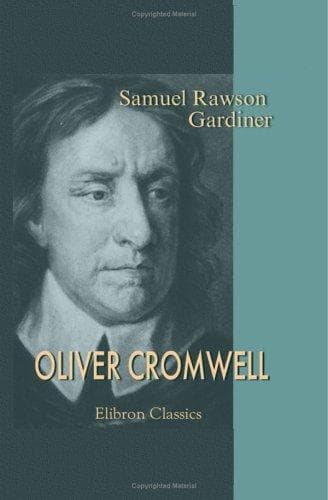
Cromwell, Oliver, 1599-1658; Great Britain -- History -- Commonwealth and Protectorate, 1649-1660
such a struggle could only be prolonged with the support of the army
was self-evident. Cromwell, however, was the last of men to desire to
establish a purely military government, and the army, to do it justice,
was commanded by men who were, for the most part, desirous to support
their general in the experiment of establishing a civil government
which would have dispensed with the interference of military power.
The tragedy--the glorious tragedy--of Cromwell's subsequent career lay
in the impossibility of permanently checking the instincts of military
politicians to intervene in favour of those guarantees regarded by them
as indispensable for the maintenance of the cause which they had so
long upheld with all their might.
Distrust of the constituencies was the prominent feature of Cromwell's
next move. The compromise offered by him of the temporary establishment
of a non-elective body to prepare a basis of settlement whilst
Parliamentary institutions remained in abeyance, was now adopted by the
officers. Lambert,--who advocated a scheme for establishing a Council
of State, apparently with provision for the increased independence
of the executive, together with the election of a Parliament with
restricted functions,--was unable to enforce his views. A small Council
of State was established to carry on current affairs, but it was in
the Council of Officers that the main question of the constitution was
to be determined. Cromwell, after some hesitation, rallied to a very
different scheme which had been suggested by Harrison, the brilliant
soldier who dreaded to see the government in the hands of any but the
Saints. Cromwell, however, whilst accepting Harrison's views on the
whole, determined to modify them, in order to make the new assembly
something more than a group of pious fanatics. He was consequently
now anxious that it should include notable personages--even Fairfax
was suggested--who had contended against the King, but who had no
connection with the extreme sections of the community which found
favour in Harrison's eyes. It was eventually resolved that the Council
of Officers should invite nominations from the Congregational Churches
in each county, reserving to itself the power of rejecting persons so
named, and also of adding names which found no place on the list. On
June 8 the persons finally selected received writs issued in the name
of Cromwell as Lord General. An attempt had been made to secure the
inclusion not only of Fairfax but of Vane, but neither of them would
accept a place in the new assembly.
Public-domain text, read in full here on John Shaqi.
Reviews
Reviews
No reviews yet
Be the first to share your thoughts on this work.
Elsewhere in the archive
Join the Discussion
Join the discussion
Sign in to leave a comment or review.
Sign InorCreate an account