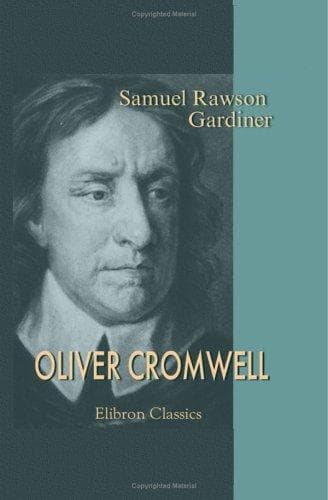
Cromwell, Oliver, 1599-1658; Great Britain -- History -- Commonwealth and Protectorate, 1649-1660
Contrary, as it would seem, to the intention of those by whom it
had been called, the new assembly audaciously assumed the name of
Parliament. Its real position being that of a mere body of nominees,
Lilburne was once more brought into the field. In 1649 Lilburne had
been tried and acquitted, but had subsequently been banished by the
Long Parliament, which had added to its sentence a declaration that he
would be guilty of felony if he, at any time, returned to England. He
now reappeared in London, where he was sent to prison, again tried, and
again acquitted. The line taken by him and his followers was that the
so-called Parliament now in existence was no Parliament at all, as it
was not elected by the people. With Cromwell's full consent, Lilburne
was retained in confinement, being ultimately removed to Jersey, where
no writ of habeas corpus could deliver him.
For a time Lilburne's attack consolidated the alliance between the Lord
General and the nominees to whom political power had been entrusted.
Yet it was not long before Cromwell's practical sense took alarm at
their proceedings. It was indeed not the case, as has often been
said, that the majority of the members were mere enthusiasts, but
the enthusiasts settled down to Parliamentary work, seldom absenting
themselves from the House, and being always ready to vote when a
division was called; whilst those who distrusted them could not always
be brought to a due sense of the importance of their Parliamentary
duties, and were apt to be led away by interest or pleasure from
supporting their opinions by their votes. Two questions were soon found
to divide the parties, that of law reform, more especially the reform
of Chancery, and that of a religious organisation other than compulsory
uniformity under Bishops or Presbyters. On both these questions
Cromwell was intensely interested, and there can be little doubt that
if the nominated Parliament had conducted itself with due regard for
practical exigencies, it would have retained his good-will to the end.
Unfortunately this was not the case. It proposed a total abolition
of the Court of Chancery, thus handing over to the hostile judges of
the Common Law that system of equity which had been growing up with
beneficial results for generations, whilst it also took in hand with a
light heart the codification of the law, though not a single practising
lawyer had a seat in the House, in the hope that 'the great volumes
of law would come to be reduced into the bigness of a pocket book'.
No wonder that Cromwell dropped into a friend's ear the words: "I am
more troubled now with the fool than with the knave". No wonder either
that in September he drew aside from Harrison, under whose influence he
had decided in favour of summoning the nominees, and that he listened
with greater respect to Lambert, the military representative of
constitutionalism and the determined opponent of political fanaticism.
Public-domain text, read in full here on John Shaqi.
Reviews
Reviews
No reviews yet
Be the first to share your thoughts on this work.
Elsewhere in the archive
Join the Discussion
Join the discussion
Sign in to leave a comment or review.
Sign InorCreate an account