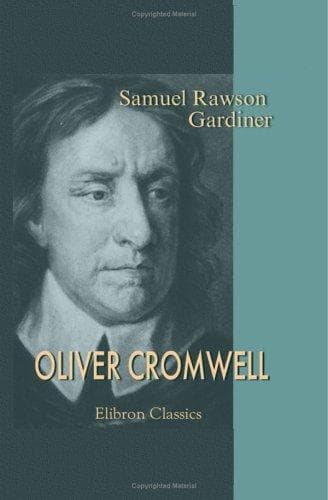
Cromwell, Oliver, 1599-1658; Great Britain -- History -- Commonwealth and Protectorate, 1649-1660
It was impossible for the Protector to put his case more convincingly.
Yet, admirable as a criticism pointing out the danger likely to follow
on the adoption of the proposals of Parliament, Oliver's reasoning
pre-supposed the acceptance by Parliament of his own conviction that an
armed minority had the right to impose its principles on the unarmed
majority--the very belief which the authors of the Parliamentary
constitution were most determined to resist. Even if it had been
possible for any Puritan party to look for a solution of the problem
in an appeal to the unfettered judgment of the nation, it is evident
that Oliver would never have agreed to such an arbitration. On the one
side was the resolve to get what appeared to be the right thing done,
if necessary by force. On the other side was the resolve to eliminate
the element of force by subordinating it to the rule of Parliaments.
For the moment the decisive word rested with Oliver. "I think myself
bound," he said in conclusion, "as in my duty to God, and to the
people of these nations, for their safety and good in every respect--I
think it my duty to tell you that it is not for the profit of these
nations, nor for common and public good for you to continue longer, and
therefore I do declare unto you, that I do dissolve this Parliament."
History has pronounced in favour of the view taken by Oliver's
antagonists. The reliance on military power in which he had found his
refuge did more than all other facts put together to establish, for
good or for evil, a reliance on Parliament. It is the special mark
of his greatness that he put his whole heart after the dissolution
of his first Parliament into an effort to avoid the appearance even
of a temporary dictatorship. He shrank from being a military ruler,
even under the plea of the necessity of the times. His holding back
the dissolution of Parliament till the fifth month--lunar month as it
was--had been accomplished, offers the key-note of the position as
he judged it. The Parliamentary constitution had perished stillborn.
The constitution of the Instrument was in full force, and was to be
observed, even though it were to his own detriment. The Instrument
enabled the Protector and Council to levy such taxation as they thought
fit for 30,000 men and for a navy sufficient for defence, whilst he had
now on foot some 57,000 soldiers, and, in addition to the home fleet,
two others had already been despatched--the one to the Mediterranean,
the other to the West Indies. Yet the Protector was able to announce
that he would content himself with levying the Assessment money at
the low amount of £80,000 a month on the three nations, an amount
which the dissolved Parliament had fixed as sufficient for the forces
named in the Instrument. Such a decision left the Government with
enormous forces--as forces were in those days reckoned--which it had
no visible means of paying; but it was an announcement in the most
Public-domain text, read in full here on John Shaqi.
Reviews
Reviews
No reviews yet
Be the first to share your thoughts on this work.
Elsewhere in the archive
Join the Discussion
Join the discussion
Sign in to leave a comment or review.
Sign InorCreate an account