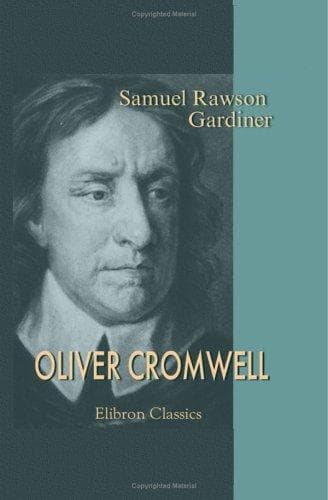
Cromwell, Oliver, 1599-1658; Great Britain -- History -- Commonwealth and Protectorate, 1649-1660
Cromwell knew that more than his own name was required to rally the
force needed at this desperate conjuncture. At his instance Parliament
appointed the new Earl of Manchester--who, as Lord Kimbolton, had
been the one member of the House of Lords marked out by the King for
impeachment together with the five members of the House of Commons--as
Commander of the Eastern Association, and ordered an army of 10,000
men to be raised within its limits. Whilst in the South, Essex
raised the siege of Gloucester, and was successful enough at Newbury
to make good his retreat to London, Manchester's new army, in which
Cromwell commanded the horse, defeated a party of Royalists at Winceby,
compelled Newcastle to raise the siege of Hull, and retook Lincoln,
which had fallen into the hands of the enemy. Lincolnshire was now
added to the Eastern Association, the one part of England on which the
eyes of the Parliamentary chiefs could rest with complete satisfaction.
Sooner or later Cromwell would have to face other questions than
those of military efficiency. When Pym and his supporters drew up
the Grand Remonstrance, they did not contemplate the introduction of
any principle of religious liberty. The Church was to be exclusively
Puritan, on some plan to be settled by Parliament upon the advice of an
Assembly of Divines. That Assembly met on July 1, 1643, and if it had
been left to itself, would probably have recommended the adoption of
some non-episcopalian system of Church-government; whilst Parliament,
faithful to the traditions of English governments, would have taken
care that the clergy should be placed under some form of lay government
emanating from Parliament itself. In the summer of 1643 it was
impossible to separate questions of ecclesiastical organisation from
those arising out of the political necessities of the hour. It was
known that Charles was angling for the support of Ireland and Scotland,
and if Parliament was not to be overborne, it was necessary to meet
him on the same ground. In Ireland Charles was fairly successful.
On September 15 his Lord Lieutenant obtained from the Confederate
Catholics, who were in arms against his Government, a cessation of
hostilities, which would enable him to divert a portion of his own
troops to the defence of the King's cause in England; ultimately, as he
hoped, to be followed by an army levied amongst the Irish Catholics.
Charles's attempt to win Scotland to his side was less successful. The
predominant party at Edinburgh was that led by the Marquis of Argyle,
who had climbed to power with the help of the Presbyterian organisation
of the Church, and who justly calculated that, if Charles gained his
ends in England, the weight of his victorious sword would be thrown
into the balance of the party led by the Duke of Hamilton. That party
however, embracing as it did the bulk of the Scottish nobility, would
not only have made short work of Argyle's political dictatorship, but
Public-domain text, read in full here on John Shaqi.
Reviews
Reviews
No reviews yet
Be the first to share your thoughts on this work.
Join the Discussion
Join the discussion
Sign in to leave a comment or review.
Sign InorCreate an account