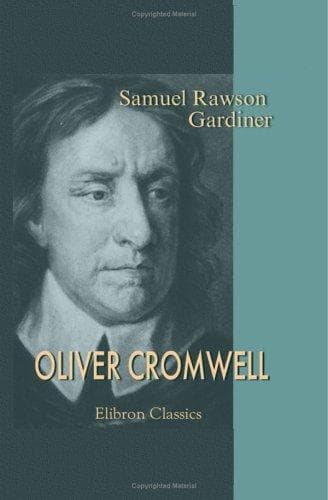
Cromwell, Oliver, 1599-1658; Great Britain -- History -- Commonwealth and Protectorate, 1649-1660
Of Oliver's father little is known; but his portrait testifies that
he was a man of sober Puritanism, not much given to any form of
spiritual enthusiasm--very unlike his elder brother, Sir Oliver, who
had inherited not only the estate, but the splendid ways of his father,
Sir Henry Cromwell--the Golden Knight--and who, after running through
his property, was compelled to sell his land and to retire into a
more obscure position. As the little Oliver grew up, he had before
his eyes the types of the future Cavalier and Roundhead in his own
family. So far as parental influence could decide the question, there
could be no doubt on which side the young Oliver would take his stand.
His education was carried on in the free school of the town, under
Dr. Beard, the author of _The Theatre of God's Judgments Displayed_,
in which a belief in the constant intervention of Providence in the
punishment of offenders was set forth by numerous examples of the
calamities of the wicked. Though Oliver afterwards learned to modify
the crudeness of this teaching, the doctrine that success or failure
was an indication of Divine favour or disfavour never left him, and he
was able, in the days of his greatness, to point unhesitatingly to the
results of Naseby and Worcester as evidence that God Himself approved
of the victorious cause.
In 1616 Cromwell matriculated at Sidney Sussex College, Cambridge,
where his portrait now adorns the walls of the College hall. After a
sojourn of no more than a year, he left the University, probably--as
his father died in that year--to care for his widowed mother and his
five sisters, he himself being now the only surviving son. It is said
that not long afterwards he settled in London to study law, and though
there is no adequate authority for this statement, it derives support
from the fact that he found a wife in London, marrying in 1620, at
the early age of twenty-one, Elizabeth Bourchier, the daughter of a
City merchant. The silence of contemporaries shows that, in an age
when many women took an active part in politics, she confined herself
to the sphere of domestic influence. The one letter of hers that is
preserved displays not merely her affectionate disposition, but also
her helpfulness in reminding her great husband of the necessity of
performing those little acts of courtesy which men engaged in large
affairs are sometimes prone to neglect. She was undoubtedly a model of
female perfection after the Periclean standard.
Public-domain text, read in full here on John Shaqi.
Reviews
Reviews
No reviews yet
Be the first to share your thoughts on this work.
Join the Discussion
Join the discussion
Sign in to leave a comment or review.
Sign InorCreate an account