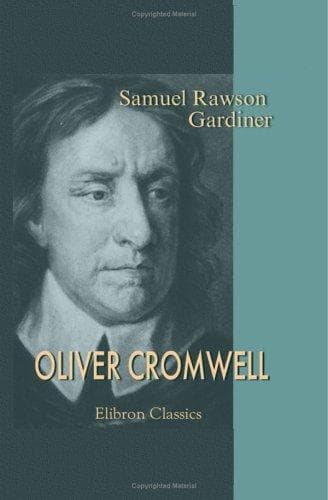
Cromwell, Oliver, 1599-1658; Great Britain -- History -- Commonwealth and Protectorate, 1649-1660
Cromwell, as was his usual habit, ascribed this success to Divine
aid. "I can say this of Naseby," he wrote, "that when I saw the enemy
draw up and march in gallant order towards us, and we a company of
poor ignorant men to seek to order our battle, the General having
commanded me to order all the horse, I could not--riding alone about
my business--but smile out to God praises in assurance of victory,
because God would, by things that are not, bring to naught things that
are, of which I had great assurance--and God did it." No doubt, as has
been said, Cromwell omitted to mention that the Parliamentary army had
numbers on its side--not much less than 14,000, opposed to 7,500. But
it was not the numerical superiority of the Parliamentarians which won
the day. It did not enable Ireton to withstand Rupert, and the infantry
in the centre was already giving way when Cromwell returned to assist
it. It was the discipline rather than the numbers of Cromwell's horse
aided by the superb generalship of their commander that gained the day.
Cromwell, when he wrote of his soldiers as 'poor ignorant men,' was
doubtless glancing back in thought at his own early criticism of the
fugitives at Edgehill. The yeomen and peasants whom he had gathered
round him owed much to discipline and leadership; but they owed much
also to the belief embedded in their hearts that they were fighting in
the cause of God.
After the victory at Naseby the issue of the struggle was practically
decided. There was another fight at Langport, where Fairfax defeated a
force with which Goring attempted to guard the western counties; but
after this the war resolved itself into a succession of sieges which
could end but in one way as Charles had no longer a field army to
bring to the relief of Royalist garrisons. For some months Cromwell,
sometimes in combination with Fairfax, sometimes in temporary command
of a separate force, was untiring in the energy which he threw into
his work. Charles was full of combinations which never resulted in
practical advantage to his cause. At one time his hopes were set upon
Montrose, who, after his brilliant victories, expected to bring an
army of Highlanders to aid of the royal cause. At another time he
looked with equal hopefulness to Glamorgan, who was to conduct an
Irish army to England. Montrose's scheme was wrecked at Philiphaugh,
and Glamorgan's concessions to the Irish Catholics were divulged and
had to be disavowed. On March 31, 1646 Sir Jacob Astley bringing 3,000
men, the last Royalist force in existence, to the relief of Charles at
Oxford, was forced to surrender at Stow-on-the-Wold. "You have done
your work," said the veteran to his captors, "and may go play, unless
you will fall out among yourselves." Though Oxford and Newark were
still untaken, the end of the war was now a mere question of days.
Public-domain text, read in full here on John Shaqi.
Reviews
Reviews
No reviews yet
Be the first to share your thoughts on this work.
Join the Discussion
Join the discussion
Sign in to leave a comment or review.
Sign InorCreate an account