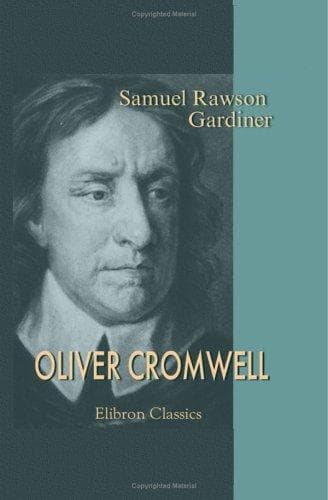
Cromwell, Oliver, 1599-1658; Great Britain -- History -- Commonwealth and Protectorate, 1649-1660
majority in accordance with the Scots were conducting with the King at
Newcastle, had been attended with success.
That Cromwell watched these negotiations with the keenest interest
may be taken for granted; but he does not seem to have had any
opportunity, as a simple member of the House, for doing more. We can
indeed only conjecture, though with tolerable certitude, that he was
well pleased with the widening of the breach between the Presbyterians
and the King, caused by the determination of Charles to make no
stipulation which would lead to the abolition of episcopacy. Nor can
he have been otherwise than well pleased when, on January 30, 1647,
the Scottish soldiers, having received part of the sum due to them
for their services in England with promise of the remainder, marched
for Scotland, having first delivered Charles over to commissioners
appointed by the English Parliament, who conducted him to Holmby House
in Northamptonshire, which had been assigned to him by Parliament as a
residence.
At last the time had arrived when a peaceful settlement of the
distracted country appeared to have come in sight and, for the time
at least, the Presbyterians seemed to have the strongest cards in
their hands. They had a majority in Parliament, and it was for
them, therefore, to formulate the principles on which the future
institutions of the country were to be built. That the country was
with them in wishing, on the one hand, for an arrangement in which
the King could reappear as a constitutional factor in the Government,
and, on the other hand, for a total or partial disbandment of the
army and a consequent relief from taxation, can hardly be denied. The
great weakness, and, as it proved, the insuperable weakness of the
Presbyterians lay in the incapacity of their leaders to understand the
characters of the men with whom they had to deal. Right as they were
in their opinion that the nation would readily accept a constitutional
monarchy, it was impossible to persuade them, as was really the
case, that Charles would never willingly submit to be bound by the
limitations of constitutional monarchy, and still less to allow,
longer than he could possibly help, the Church to be modelled after
any kind of Presbyterian system. That he had the strongest possible
conviction on religious grounds that episcopacy was of Divine ordinance
is beyond doubt, and on this point his tenacious, though irresolute,
mind was strengthened by an assurance that in fighting in the cause
of the bishops he was really fighting in the cause of God. Yet the
controversy had a political as well as a religious side. In Scotland
Presbyterianism meant the predominance of the clergy. In England
it would mean the predominance of the country nobility and gentry,
who, either in their private capacity or collectively in Parliament,
presented to benefices, and in Parliament kept the final control over
the Church in their own hands. Episcopacy, on the other hand, meant
Public-domain text, read in full here on John Shaqi.
Reviews
Reviews
No reviews yet
Be the first to share your thoughts on this work.
Join the Discussion
Join the discussion
Sign in to leave a comment or review.
Sign InorCreate an account