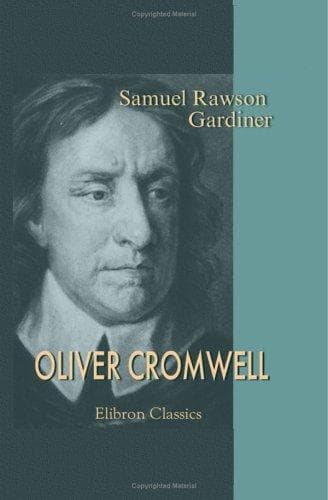
Cromwell, Oliver, 1599-1658; Great Britain -- History -- Commonwealth and Protectorate, 1649-1660
Before the irrevocable step was taken, Parliament sent commissioners to
persuade the army to disband on the payment of an additional £10,000.
On the 10th, the commissioners finding the soldiers at a rendezvous on
Triploe Heath were received by a general refusal to accept the terms
till they had been examined by the new Army Council. The army then
significantly marched to Royston, several miles on the road to London.
In the evening a letter was sent off to the magistrates of the City,
the chief supporters of the new Presbyterian military organisation.
It can hardly be questioned that this letter represented the ideas
at that time entertained by Cromwell, or that in great part, if not
entirely, it was written by him. Striving to blind himself to the
fact that he was heading military resistance to the civil power,
he announced that those in whose name he spoke were acting, not as
soldiers, but as Englishmen. "We desire," he proceeded, "a settlement
of the kingdom and of the liberties of the subject according to the
votes and declarations of Parliament which, before we took up arms,
were by Parliament used as arguments and inducements to invite us and
divers of our dear friends out--some of whom have lost their lives in
this war, which being by God's blessing finished, we think we have as
much right to demand and see a happy settlement, as we have to our
money, or the other common interest of soldiers that we have insisted
upon." Then followed a renewal of the protest that the army had no wish
to introduce licentious liberty, or to subvert the Civil Government.
"We profess," continued Cromwell, "as ever in these things, when the
State has once made a settlement, we have nothing to say, but submit or
suffer. Only we could wish that every good citizen and every man that
walks peacefully in a blameless conversation, may have liberties and
encouragements, it being according to the just policy of all States,
even to justice itself." Then followed the practical conclusion. "These
things are our desires--beyond which we shall not go, and for the
obtaining these things we are drawing near your city--declaring with
all confidence and assurance that, if you appear not against us in
these our just desires, to assist that wicked party that would embroil
us and the kingdom, neither we nor our soldiers shall give you the
least offence." Should things proceed otherwise, it would not be the
army that would give way. "If after all this," continued Cromwell,
"you, or a considerable number of you, be seduced to take up arms in
opposition to, or hindrance of these our just undertakings, we hope, by
this brotherly premonition, we have freed ourselves from all that ruin
which may befall that great and populous city; having hereby washed our
hands thereof."
Public-domain text, read in full here on John Shaqi.
Reviews
Reviews
No reviews yet
Be the first to share your thoughts on this work.
Join the Discussion
Join the discussion
Sign in to leave a comment or review.
Sign InorCreate an account