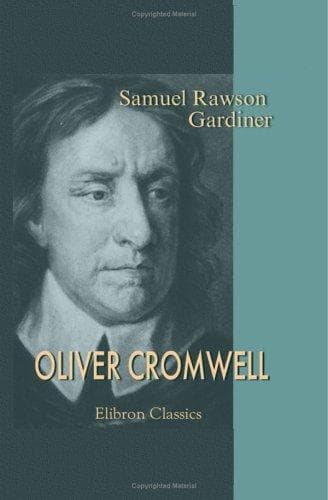
Cromwell, Oliver, 1599-1658; Great Britain -- History -- Commonwealth and Protectorate, 1649-1660
rational men in the world as the most contemptiblest generation of
silly, low-spirited men in the earth, to be broken and routed by such a
despicable, contemptible generation of men as they are, and therefore,
Sir, I tell you again, you are necessitated to break them." We can
sympathise with Lilburne now in his desire to establish government by
the people, to confirm individual right, and to restrain the commanders
of the army from political power. Yet, after all, the practical
necessities of the hour were on Cromwell's side.
It was not long before the mutinous spirit to which Lilburne appealed
showed itself in the army. A regiment quartered at Salisbury refused
obedience to its officers, and roamed about the country seeking for
other bodies of troops with which to combine. Fairfax set out from
London in chase, and on the night of May 14 Cromwell, by a forced
march with his cavalry, overtook the mutineers at Burford. Three were
executed, and the remainder submitted to the inevitable.
It was the more necessary to keep the army in hand, as there was
renewed fighting in prospect. The eldest son of the late King, now
claiming the title of Charles II., was about to make an effort to seat
himself on his father's throne, and hoped, as his father had hoped
before him, to have on his side the forces of Scotland and Ireland.
For many years the problem of the relations between the three countries
had been inviting a solution. Both Scotland and Ireland had social
and political interests of their own, and the natural reluctance of
the inhabitants of either country to see these merged in those of the
wealthier and more numerous people of England would in any case have
called for delicate handling. The rise for the first time of a powerful
army in England made her relations with the two other countries even
more difficult than before, and had contributed fully as much as
zeal for Presbyterianism to the ridiculous scheme of re-establishing
Charles I. as a covenanting King. After the defeat of Hamilton, indeed,
Argyle and the Scottish clergy had welcomed Cromwell's support in
the overthrow of the power of the nobility, but the dread of English
predominance had not been entirely dispelled, and the King's execution
added a sentimental grievance to other causes of alarm. In refusing
to allow any English government to dispose of Scotland, the Scots
were undoubtedly within their rights; but when on February 5 they
proclaimed Charles II. not merely as King of Scotland, but as King
of Great Britain, France and Ireland, they took up a position which
no English government could allow to remain unchallenged, whilst in
adding a condition that Charles was to be admitted to power only on his
engagement to rule according to the National Covenant and the Solemn
League and Covenant, they put forward the monstrous claim to control
the religious development of England and Ireland, as well as of their
own country.
Public-domain text, read in full here on John Shaqi.
Reviews
Reviews
No reviews yet
Be the first to share your thoughts on this work.
Elsewhere in the archive
Join the Discussion
Join the discussion
Sign in to leave a comment or review.
Sign InorCreate an account