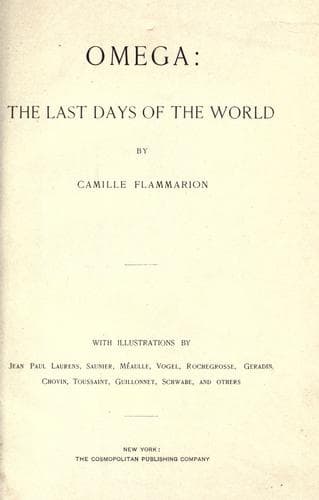
Omega: The Last days of the WorldFlammarion, Camille
Philosophy
Omega: The Last days of the World
Flammarion, Camille
End of the world -- Fiction; Science fiction
Then, too, during the three months whose history we have recapitulated,
the comet had emerged from regions accessible only to the telescope and
had become visible to the naked eye. In full view of the earth it
hovered now like a threat from heaven among the army of stars. Terror
itself, advancing slowly but inexorably, was suspended like a mighty
sword above every head. A last effort was made, not indeed to turn the
comet from its path—an idea conceived by that class of visionaries who
recoil before nothing, and who had even imagined that an electric storm
of vast magnitude might be produced by batteries suitably distributed
over that face of the globe which was to receive the shock—but to
examine once more the great problem under every aspect, and perhaps to
reassure the public mind and rekindle hope by the discovery of some
error in the conclusions which had been drawn, some forgotten fact in
the observations or computations. This collision might not after all
prove so fatal as the pessimists had foretold. A general presentation of
the case from every point of view was announced for this very Monday at
the Institute, just four days before the prophesied moment of collision,
which would take place on Friday, July 13th. The most celebrated
astronomer of France, at that time director of the Paris observatory;
the president of the academy of medicine, an eminent physiologist and
chemist; the president of the astronomical society, a skillful
mathematician, and other orators also, among them a woman distinguished
for her discoveries in the physical sciences, were among the speakers
announced. The last word had not yet been spoken. Let us enter the
venerable dome and listen to the discussion.
But before doing so, let us ourselves consider this famous comet which
for the time being absorbed every thought.
CHAPTER II.
[Illustration:
THE STREET TELESCOPES.
]
The stranger had emerged slowly from the depths of space. Instead of
appearing suddenly, as more than once the great comets have been
observed to do,—either because coming into view immediately after their
perihelion passage, or after a long series of storms or moonlight nights
has prevented the search of the sky by the comet-seekers—this floating
star-mist had at first remained in regions visible only to the
telescope, and had been watched only by astronomers. For several days
after its discovery, none but the most powerful equatorials of the
observatories could detect its presence. But the well-informed were not
slow to examine it for themselves. Every modern house was crowded with a
terrace, partly for the purpose of facilitating aerial embarkations.
Many of them were provided with revolving domes. Few well-to-do families
were without a telescope, and no home was complete without a library,
well furnished with scientific books.
Public-domain text, read in full here on John Shaqi.
Reviews
Reviews
No reviews yet
Be the first to share your thoughts on this work.
Join the Discussion
Join the discussion
Sign in to leave a comment or review.
Sign InorCreate an account