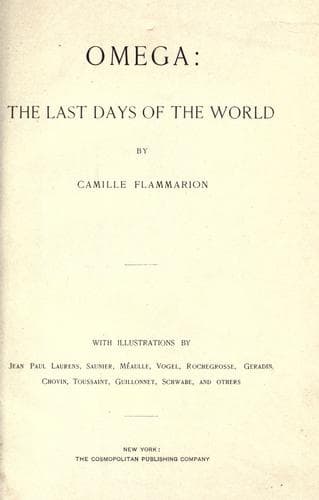
Omega: The Last days of the WorldFlammarion, Camille
Philosophy
Omega: The Last days of the World
Flammarion, Camille
End of the world -- Fiction; Science fiction
It has been remarked, we believe, that the Paris observatory, always in
the van of every scientific movement, by virtue of the labors of its
members, and more especially, of improved methods of observation, had
become, on the one hand, the sanctuary of theoretical research, and on
the other the central telephone bureau for stations established at a
distance from the great cities on elevations favored by a perfectly
transparent atmosphere.
[Illustration:
_By Jean Paul Laurens._
]
It was an asylum of peace, where perfect concord reigned, where
astronomers disinterestedly consecrated their whole lives to the
advancement of science, and mutually encouraged each other, without
experiencing any of the pangs of envy, each forgetting his own merit to
proclaim that of his colleagues. The director set the example, and when
he spoke it was in the name of all.
He published a technical discussion, and he was listened to—for a
moment. For the question appeared to be no longer one of astronomy. No
one denied or disputed the meeting of the comet with the earth. That was
a fact which mathematics had rendered certain. The absorbing question
now was the chemical constitution of the comet. If the earth, in its
passage through it, was to lose the oxygen of its atmosphere, death by
asphyxia was inevitable; if, on the other hand, the nitrogen was to
combine with the cometary gases, death was still certain; but death
preceded by an ungovernable exhilaration, a sort of universal
intoxication, a wild delirium of the senses being the necessary result
of the extraction of nitrogen from the respirable air and the
proportionate increase of oxygen.
The spectroscope indicated especially the presence of carbonic-oxide in
the chemical constitution of the comet. The chief point under discussion
in the scientific reviews was whether the mixture of this noxious gas
with the atmosphere would poison the entire population of the globe,
human and animal, as the president of the academy of medicine affirmed
would be the case.
Carbonic-oxide! Nothing else was talked of. The spectroscope could not
be in error. Its methods were too sure, its processes too precise.
Everybody knew that the smallest admixture of this gas with the air we
breathe meant a speedy death. Now, a later despatch from the observatory
of Gaurisankar had more than confirmed that received from Mount
Hamilton. This despatch read:
“The earth will be completely submerged in the nucleus of the comet,
whose diameter is already thirty times that of the globe and is daily
increasing.”
Thirty times the diameter of the earth! Even then, though the comet
should pass between the earth and the moon, it would touch them both,
since a bridge of thirty earths would span the distance between our
world and the moon.
Public-domain text, read in full here on John Shaqi.
Reviews
Reviews
No reviews yet
Be the first to share your thoughts on this work.
Join the Discussion
Join the discussion
Sign in to leave a comment or review.
Sign InorCreate an account