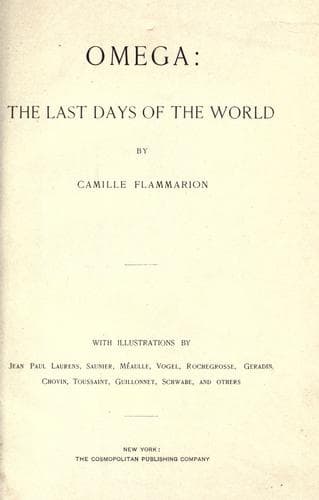
Omega: The Last days of the WorldFlammarion, Camille
Philosophy
Omega: The Last days of the World
Flammarion, Camille
End of the world -- Fiction; Science fiction
Moreover, astronomers themselves had not, at first, evinced any anxiety
about the collision, so far as it affected the fate of humanity, and the
astronomical journals (which alone retained any semblance of authority)
had as yet referred to the subject simply as a computation to be
verified. Scientists had treated the problem as one of pure mathematics,
regarding it only as an interesting case of celestial mechanics. In the
interviews to which they had been subjected they had contented
themselves with saying that a collision was possible, even probable, but
of no interest to the public.
Meanwhile, a new message was received by telephone, this time from Mount
Hamilton in California, which produced a sensation among the chemists
and physiologists:
“Spectroscopic observation establishes the fact that the comet is a body
of considerable density, composed of several gases the chief of which is
carbonic-oxide.”
Matters were becoming serious. That a collision with the earth would
occur was certain. If astronomers were not especially preoccupied by
this fact, accustomed as they were for centuries to consider these
celestial conjunctions as harmless: if the most celebrated even of their
number had, at last, coldly shown the door to the many beardless
reporters constantly importuning them, declaring that this prediction
was of no interest to the people at large and was a strictly
astronomical question which did not concern them, physicians, on the
other hand, had begun to agitate the subject and to discuss gravely,
among each other, the possibilities of asphyxia, or poisoning. Less
indifferent to public opinion, so far from turning a cold shoulder to
the journalists, they had welcomed them, and in a few days the subject
suddenly entered upon a new phase. From the domain of astronomy it had
passed into that of philosophy, and the name of every well-known or
famous physician appeared in large letters on the title-pages of the
daily papers; their portraits were reproduced in the illustrated
journals, and the formula, “Interviews on the Comet,” was to be seen on
every hand. Already, even, the variety and diversity of conflicting
opinions had created hostile camps, which hurled at each other the most
grotesque abuse, and asserted that all physicians were “charlatans eager
for notoriety.”
In the mean time the director of the Paris observatory having at heart
the interests of science, was profoundly disturbed by an uproar which
had more than once, on former occasions, singularly misrepresented
astronomical facts. He was a venerable old man who had grown gray in the
study of the great problems of the constitution of the universe. His
utterances were respected by all, and he had decided to make a statement
to the press in which he declared that all conjectures, made prior to
the technical discussion authorized by the Institute, were premature.
Public-domain text, read in full here on John Shaqi.
Reviews
Reviews
No reviews yet
Be the first to share your thoughts on this work.
Join the Discussion
Join the discussion
Sign in to leave a comment or review.
Sign InorCreate an account