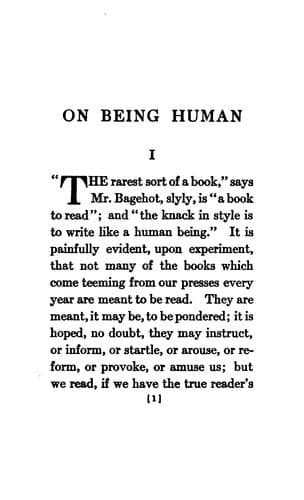
There are a few children in every generation, as Mr. Bagehot reminds
us, who think the natural thing to do with any book is to read it.
“There is an argument from design in the subject,” as he says; “if the
book was not meant to be read for that purpose, for what purpose was it
meant?” These are the young eyes to which books yield up great
treasure, almost in spite of themselves, as if they had been penetrated
by some swift, enlarging power of vision which only the young know. It
is these youngsters to whom books give up the long ages of history,
“the wonderful series going back to the times of old patriarchs with
their flocks and herds”—I am quoting Mr. Bagehot again—“the keen-eyed
Greek, the stately Roman, the watching Jew, the uncouth Goth, the
horrid Hun, the settled picture of the unchanging East, the restless
shifting of the rapid West, the rise of the cold and classical
civilization, its fall, the rough impetuous Middle Ages, the vague warm
picture of ourselves and home. When did we learn these? Not yesterday
nor today, but long ago, in the first dawn of reason, in the original
flow of fancy.” Books will not yield to us so richly when we are older.
The argument from design fails. We return to the staid authors we read
long ago, and do not find in them the vital, speaking images that used
to lie there upon the page. Our own fancy is gone, and the author never
had any. We are driven in upon the books meant to be read.
These are books written by human beings, indeed, but with no general
quality belonging to the kind—with a special tone and temper, rather, a
spirit out of the common, touched with a light that shines clear out of
some great source of light which not every man can uncover. We call
this spirit human because it moves us, quickens a like life in
ourselves, makes us glow with a sort of ardor of self-discovery. It
touches the springs of fancy or of action within us, and makes our own
life seem more quick and vital. We do not call every book that moves us
human. Some seem written with knowledge of the black art, set our base
passions aflame, disclose motives at which we shudder—the more because
we feel their reality and power; and we know that this is of the devil,
and not the fruitage of any quality that distinguishes us as men. We
are distinguished as men by the qualities that mark us different from
the beasts. When we call a thing human we have a spiritual ideal in
mind. It may not be an ideal of that which is perfect, but it moves at
least upon an upland level where the air is sweet; it holds an image of
man erect and constant, going abroad with undaunted steps, looking with
frank and open gaze upon all the fortunes of his day, feeling even and
again—
Public-domain text, read in full here on John Shaqi.
Reviews
Reviews
No reviews yet
Be the first to share your thoughts on this work.
Join the Discussion
Join the discussion
Sign in to leave a comment or review.
Sign InorCreate an account