“. . . the joy 1
Of elevated thoughts; a sense sublime
Of something far more deeply interfused.
Whose dwelling is the light of setting suns.
And the round ocean and the living air,
And the blue sky, and in the mind of man:
A motion and a spirit, that impels
All thinking things.”
Say what we may of the errors and the degrading sins of our kind, we do
not willingly make what is worst in us the distinguishing trait of what
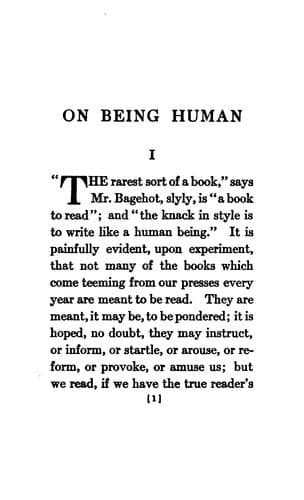
is human. When we declare, with Bagehot, that the author whom we love
writes like a human being, we are not sneering at him; we do not say it
with a leer. It is in token of admiration, rather. He makes us like our
humankind. There is a noble passion in what he says, a wholesome humor
that echoes genial comradeships; a certain reasonableness and
moderation in what is thought and said; an air of the open day, in
which things are seen whole and in their right colors, rather than of
the close study or the academic class-room. We do not want our poetry
from grammarians, nor our tales from philologists, nor our history from
theorists. Their human nature is subtly transmuted into something less
broad and catholic and of the general world. Neither do we want our
political economy from tradesmen nor our statesmanship from mere
politicians, but from those who see more and care for more than these
men see or care for.
II
Once—it is a thought which troubles us—once it was a simple enough
matter to be a human being, but now it is deeply difficult; because
life was once simple, but is now complex, confused, multifarious.
Haste, anxiety, preoccupation, the need to specialize and make machines
of ourselves, have transformed the once simple world, and we are
apprised that it will not be without effort that we shall keep the
broad human traits which have so far made the earth habitable. We have
seen our modern life accumulate, hot and restless, in great cities—and
we cannot say that the change is not natural: we see in it, on the
contrary, the fulfillment of an inevitable law of change, which is no
doubt a law of growth, and not of decay. And yet we look upon the
portentous thing with a great distaste, and doubt with what altered
passions we shall come out of it. The huge, rushing, aggregate life of
a great city—the crushing crowds in the streets, where friends seldom
meet and there are few greetings; the thunderous noise of trade and
industry that speaks of nothing but gain and competition, and a
consuming fever that checks the natural courses of the kindly blood; no
leisure anywhere, no quiet, no restful ease, no wise repose—all this
shocks us. It is inhumane. It does not seem human. How much more likely
does it appear that we shall find men sane and human about a country
fireside, upon the streets of quiet villages, where all are neighbors,
where groups of friends gather easily, and a constant sympathy makes
the very air seem native! Why should not the city seem infinitely more
Public-domain text, read in full here on John Shaqi.
Reviews
Reviews
No reviews yet
Be the first to share your thoughts on this work.
Join the Discussion
Join the discussion
Sign in to leave a comment or review.
Sign InorCreate an account