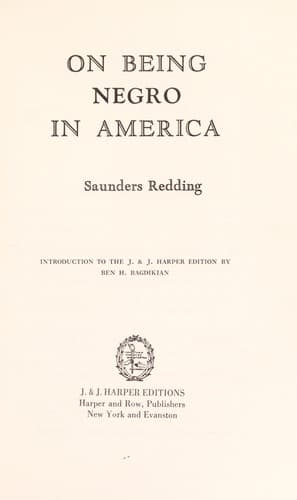
On Being Negro in AmericaRedding, J. Saunders (Jay Saunders)
General
On Being Negro in America
Redding, J. Saunders (Jay Saunders)
African Americans -- Race identity; Redding, J. Saunders (Jay Saunders), 1906-1988; United States -- Race relations
This was a blow—but that is to put it mildly. In our town, as elsewhere
in border state and northerly towns, the pattern of a strong, single
Negro leadership was fixed (and so, I suspect, was the pattern of a
strong, single Polish and Italian and Jewish leadership), and now the
white people were in a quandary. The pattern had been broken; they
themselves had knocked down the stanchion that gave stability to race
relations. A bond issue was coming up, and Negro backing was
indispensable to its success. Hitherto the white people had influenced
the direction of Negro thought through local Negro leaders. But who were
the leaders now? The white people needed them; they felt uncomfortable
and even frightened without them; they needed to know and to control, if
possible, what the Negroes were thinking. The race riots in Northern
cities—Washington, Chester, Chicago—were still green in memory, and
Wilmington itself had almost plunged into that civic horror. Congress
just then was drumming up a Bolshevist scare, and Congressman James
Byrnes, of South Carolina, had called for indictments for sedition
against certain national Negro spokesmen.[6]
But the Negroes were equally lost and frightened by the immutable
evidence of their own factionalism—and frightened the more that white
people knew of it. So long as they could seem to maintain a solid front,
no matter what internal tensions actually rived them, they felt
reasonably safe. But “Now the white people can cut us up,” my father
said. “We are divided.” It never occurred to him that the last thing in
the world the white people wanted was a divided Negro population.
Enforced segregation and the caste system were proof that they did not.
My father, who had spent more than two thirds of his life above the
Mason-Dixon line, hated segregation, but he had developed the
ghetto-mind which made it bearable and safe.
A war of impulses was (and is, I fear) going on all the time in both
whites and Negroes. It is the symptom of an American psychological
malady. It is also an indictment of our culture and an offense against
democracy. Many understand this now, but most do not. Indeed, most have
built sophistic bulwarks against understanding. They do not know this,
for the many small, subtle fallacies which they abide through force of
habit lessen their sense of moral conflict when they are faced with the
great contradiction. My father’s saying, “Don’t ever trust a white man,”
is in intent no different from the white man’s saying, “All niggers look
alike to me.” The phrases represent the lowest common denominator in the
American race-experience. They are the essence of empiricism. They voice
experiences so debased and so bereft of humaneness as utterly to
discredit our way of life in the eyes of the world. They deny the
inspiring first principle of democracy—that the person counts as person,
no matter what his color or creed.
Public-domain text, read in full here on John Shaqi.
Reviews
Reviews
No reviews yet
Be the first to share your thoughts on this work.
Join the Discussion
Join the discussion
Sign in to leave a comment or review.
Sign InorCreate an account