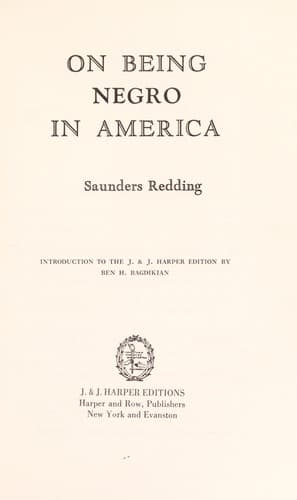
On Being Negro in AmericaRedding, J. Saunders (Jay Saunders)
General
On Being Negro in America
Redding, J. Saunders (Jay Saunders)
African Americans -- Race identity; Redding, J. Saunders (Jay Saunders), 1906-1988; United States -- Race relations
For the coming of the Garveyites shattered the defensive bulwark around
the protective community of Negroes. The whites did not understand this
at first, nor ever fully. Accustomed as they were to thinking of the
Negro as an undifferentiated caste, they could not be expected to. Where
there had seemed to be solidarity, there were factions. Where there had
been one leadership, now there were more. Where it had been common to
associate the force in the local Negro world with individuals, now the
mass seemed to rear up faceless; and where no spontaneous drive had
seemed to exist, now there was a hum of self-generating energy. The
whites did not understand, but some of them found and took an advantage.
In our district which, with only a scattered thirty per cent of the
population white, was fast becoming a ghetto, Negroes had enjoyed
political control. They had had no trouble electing one of their own to
the school board and another to the city council. The same men had been
returned to office time and again. What they did there (and they did
little) seemed not nearly so important as just being there. They had
enormous prestige and influence among Negroes, and they had not had to
fight to keep it.
But in the fall elections of that year they did. Directed by agents from
New York, the local Garveyites put up their own candidates, chosen on
class lines: the encumbents who, in the common phrase, were “dickties,”
found their following split. The campaign smelled of pitch and brimstone
and led to street brawls between the sadly outnumbered teen-aged
children of the encumbent faction and the Garveyites. Still the whites
understood only enough of what was happening to give it burlesque
treatment in the press. But the agents from New York were professionals,
and their professionalism soon showed itself. They made a deal with the
white leaders in the ward. Before the Negroes knew anything, the whites
had picked their own candidates, and while Negroes fought one another,
whites won the offices.
Public-domain text, read in full here on John Shaqi.
Reviews
Reviews
No reviews yet
Be the first to share your thoughts on this work.
Join the Discussion
Join the discussion
Sign in to leave a comment or review.
Sign InorCreate an account