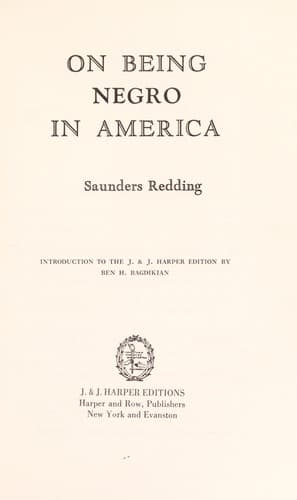
On Being Negro in AmericaRedding, J. Saunders (Jay Saunders)
General
On Being Negro in America
Redding, J. Saunders (Jay Saunders)
African Americans -- Race identity; Redding, J. Saunders (Jay Saunders), 1906-1988; United States -- Race relations
The assumptions that were held valid in my boyhood were all wrong. So
much has been said about them that I mention them reluctantly, but their
strength is attested by the fact that many, many still trust them. And
not merely Southern whites, and the misinformed, and the ignorant; nor
whites alone, but blacks. Hodding Carter, novelist and Pulitzer
prize-winning journalist, no doubt deserves his reputation as a Southern
liberal, but only a few months ago he wrote of “a common insistence upon
white political domination in the South,” which is “as unbreakable as
anything woven by the mind of man,” and declared himself unalterably
committed to race segregation on the ground of preserving the white
race’s “ethnic integrity.” Somewhat earlier, the Georgia Commissioner of
Agriculture had said, “The yellow people, the brown people and the
blacks”—not even bothering to add “people”—“are mentally unfit for
directors in our form of government.” And in 1951 Kerr Scott, the
Governor of North Carolina (“most liberal state in the South”) echoed
the Georgian. Asked by a Negro reporter why his inaugural promise had
been fulfilled only to the extent of making one Negro appointment, the
Governor snapped, “If I were you I’d never have asked that question. I
have given you [people] more than you can handle.... That’s why I tell
you you should never have asked that question.”
So the old assumptions hold: the assumption of the Negro’s inherent
inferiority; of tragic social and cultural consequences if segregation
is broken down on any but the most superficial levels; of Negroes
preferring segregation, and many more. They were taken on in the first
place as rationalizations by means of which the white man tried, as
Gunnar Myrdal says, “to build a bridge of reason” between his acclaimed
equalitarian creed and his countervailing deed. Because of this
guilt-ridden adoption, they were the more avidly loved. They were also
the more furiously drummed into the general consciousness where,
reverberating like thunder in a valley, they have rolled out the tune to
which white people and Negroes have danced since 1900—the Negroes
because they must.
It is a static but a curiously hectic dance. We gyrate through its
complicated patterns with responses as conditioned and involuntary as
reflexes. In spite of all the fervent clapping and shouting, our
reactions to the race problem are not really emotional and intellectual,
but muscular. I cannot now, as long ago I could, believe in the moral
and intellectual conviction of the demagogues, of men like Richard
Russell and James Byrnes and Strom Thurmond; for I cannot believe that
the findings of modern science are so cabined and confined, even in
South Carolina, Georgia and Mississippi, as to have escaped the
knowledge of these educated men. The older demagogues had this to excuse
them; they were ignorant. The younger ones are knowing puppeteers,
cynically manipulating the strings of the past.
Public-domain text, read in full here on John Shaqi.
Reviews
Reviews
No reviews yet
Be the first to share your thoughts on this work.
Join the Discussion
Join the discussion
Sign in to leave a comment or review.
Sign InorCreate an account