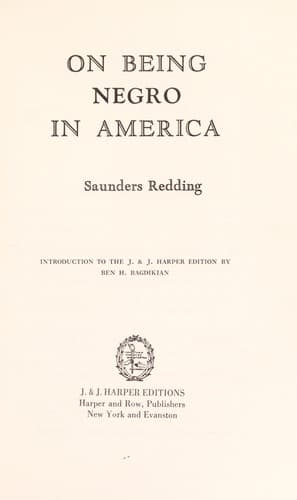
On Being Negro in AmericaRedding, J. Saunders (Jay Saunders)
General
On Being Negro in America
Redding, J. Saunders (Jay Saunders)
African Americans -- Race identity; Redding, J. Saunders (Jay Saunders), 1906-1988; United States -- Race relations
And even the masses who respond to the strings know better than they
used to; even with them conviction flags and cynicism takes over. The
moral conviction that it was for the social welfare that they reserved
all power to themselves no longer operates. Power for power’s sake is
now the rule, and when a leading Georgia politician said so in a
political address, the rafters rang. “We have the power and we mean to
keep it where it belongs. If the Negroes vote wholesale, and if the
county unit system goes, we’ll have that much less power. But it must
not go. The county unit system, which used to protect our rural
population from slick city politics, now arms us all with power against
the enemies of white supremacy.”
The old assumptions hold, but, worse, others have been added to evade
the knowledge that cannot now be ignored and to make possible the
conformity to the vicious dialectic of power which rings as plangently
in America now as in the rest of the world. And the chief of them is
this—that hostility is the accepted state in which to live. Dualism is
looked on as the natural division of absolute opposites, of enemies:
Communism and democracy, Eastern man and Western man, native and
foreign, and, most pertinent to this argument, black and white. Not
black as formerly—the pathetically weak and erring child of nature; nor
white as formerly—the tolerant chastiser and protector, the strong
adult. But black raised by the findings of science (and the decisions of
the highest court in the land) to close equality with white, and
therefore the enemy to white.
Exaggerated? But toward truth, not away from it. That competition, which
was once confined to the lowest economic levels and which resulted in
the legendary hatred of the poor-white masses for the Negro and vice
versa, operates on higher levels now. It is on the level of skilled
labor, as the Brotherhood of Locomotive Engineers and Firemen knew when
they brought suit to enjoin railroads from promoting Negro firemen (also
members of the Brotherhood) to engineers. It is on the level of
education, and persons reported to be students of the medical college of
the University of South Carolina admitted sending threatening letters to
a Negro applicant and burning a cross on his front lawn. It is on the
level of the professions, so that a committee of the National Bar
Association, a Negro group, felt constrained to report that “as the
quality of training rises, Negro lawyers find it harder to win admission
to the bar in some Southern states.”
Public-domain text, read in full here on John Shaqi.
Reviews
Reviews
No reviews yet
Be the first to share your thoughts on this work.
Join the Discussion
Join the discussion
Sign in to leave a comment or review.
Sign InorCreate an account