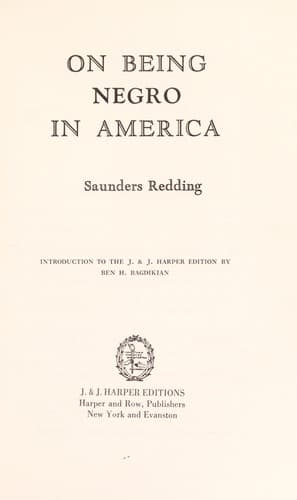
On Being Negro in AmericaRedding, J. Saunders (Jay Saunders)
General
On Being Negro in America
Redding, J. Saunders (Jay Saunders)
African Americans -- Race identity; Redding, J. Saunders (Jay Saunders), 1906-1988; United States -- Race relations
He swung his head from side to side and his face smiled at me. “I know.
And I know more,” he said. He called off items of biographical fact as
if he were reading from a file card—the year and place of my birth, my
father’s name, my brother’s name, my schooling, an attack of scarlet
fever I had had. Momentarily I half expected him to go into an account
of monstrous crimes I had committed in some other and unremembered
character. It seems silly now, for I know that to get such information
as he had was an easy matter, but then I felt that for some dark purpose
I could not guess a million pairs of eyes had followed me since birth.
I do not wish to play up this episode nor to dramatize my reaction to
it, for what followed was ridiculous emotional anticlimax. Through the
next talk Philip had with me a week or so later, his efforts to get on
terms of easy familiarity dissipated my sense of being mysteriously
overpowered and exposed. I did not respond to the first-name
camaraderie. Not knowing his last name, I avoided calling him anything.
I think my formal civility frustrated him, and I think this is why, in a
kind of desperation during the third or fourth meeting, he pulled out a
folder of very detailed obscene photographs and handed them to me. He
laughed when he asked in pretended casualness (for I could feel him
watching me sharply) whether I had seen anything like them before. And
weren’t they the most amusing things, and one in particular, because he
knew the girl in it—a student at the art school. He had some “delicious”
friends, he said, and he would like me to meet them. He said that there
was one “bonnie brunette especially, from ‘way down in Georgia—but
completely, and I mean completely, emancipated” and without prejudice.
They lined up fast enough once they were really free, he said, and it
only went to show what would happen to the race problem all over the
country were it not for the strength and pressure of reaction. “There
just wouldn’t be any if it were left to the women.”
I think Philip was running ’way ahead of his timetable. Or, to change
the figure, he had cast his net on the wrong tide. There was not enough
weight to it in any case. I knew later that there was quite a potential
catch of assorted fish, including a young college student who wore very
thick glasses, a French-descended politician who had considerable power
in local labor circles, and a very wealthy widow in her late thirties.
Even then the widow was contributing generously to the cell, and some
years later she became nationally known as pro-Communist. There were
others too, but I do not know how they had been approached, nor how many
were caught. Perhaps Philip and those who joined him in subsequent weeks
fumbled the assignment badly. At least this one got away. The approach
to my intellect is not through my gonads.
Public-domain text, read in full here on John Shaqi.
Reviews
Reviews
No reviews yet
Be the first to share your thoughts on this work.
Join the Discussion
Join the discussion
Sign in to leave a comment or review.
Sign InorCreate an account